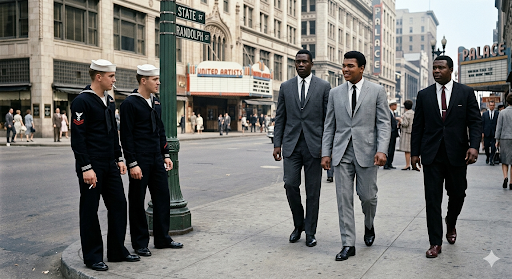
In 1966, I was training at the Great Lakes Naval Base outside Chicago. I had enlisted in the Navy with the conviction that destiny was pulling me toward Vietnam, where I imagined myself serving as a Marine Corps medic. That belief came from a recurring dream—one that felt less like fantasy and more like prophecy.
My company commander assigned me to bathroom duty. It wasn’t punishment; in fact, it was recognition. With my nursing background, I was the most qualified to keep the place spotless. Inspections were relentless, and the bathrooms were the hardest test. A streak on a mirror could cost the company its cigarette breaks or liberty passes. The upside was that I skipped morning drills and even earned a two‑day liberty pass.
Chicago was unfamiliar territory. I’d only been there once before, riding in my high school friend Jerry’s brand‑new Chevy Corvair convertible. We visited his brother at the university, but what stuck in my memory wasn’t the campus—it was the surreal sight of young women in skimpy outfits swinging in storefront windows.
This time, I wasn’t interested in revisiting that street. Instead, I headed to the USO, where I learned I could get free tickets to local events. Classical music had always been a quiet passion of mine, so when I heard the Chicago Symphony was performing that night—with Van Cliburn as guest pianist—I jumped at the chance. Mike, a fellow recruit who knew the city better than I did, joined me.
We arrived in our dress blues, only to realize the rest of the audience was in formal attire. From our balcony seats, we tried to blend in, mimicking the gestures of those around us, much like newcomers at a Pentecostal service. When the conductor introduced Van Cliburn, the hall erupted in applause. The performance was breathtaking—an evening that felt worlds away from the grit of naval training.
As Cliburn’s fingers danced across the keys, I thought about the strange path that had brought me here: a dream of war, a bathroom mop, and now a balcony seat in Chicago’s temple of music. His playing carried both triumph and vulnerability, reminding me that service—whether through art or arms—was always a negotiation between duty and destiny.
Afterward, we checked into a USO‑recommended hotel across from the Wrigley Building, lured by a military discount. Inside, however, it was clear: just boys pretending to be men. Someone had smuggled in bottles of vodka, but the hotel lacked an ice machine. Paper cups were passed around. I took a sip, gagged, and slipped into the hallway, searching for a discreet way to pour it out. On a couch nearby, one of the recruits was tangled up with a heavily made‑up woman. I wondered if she might have been one of those swinging girls from years before.
Mike and I eventually found a quiet spot to sleep. At dawn, we washed up in a bathroom and set out to find breakfast. Mike suggested a restaurant, but when the taxi dropped us off, it was nowhere to be found. Standing on the corner, uncertain, we noticed three impeccably dressed Black men approaching. Their stride was unusual—confident, almost theatrical.
“Good morning, gentlemen,” the leader said, extending his hand. “How is your day?”
“Just fine, sir,” we replied.
“I want you to know I respect you for serving our country. For religious reasons, I cannot join the military, but I appreciate those who do. Have a good day, gentlemen.”
We stood speechless as they walked away. Mike turned to me, his voice low but tinged with awe.
“Do you know who that was?”
I shook my head.
Mike smiled. “That was Cassius Clay.”
That night in Chicago, I realized life is a symphony of crossings—some marked by music, some by handshakes, all leading us down roads we never expected to walk.”


