This is a piece I first wrote years ago, but its meaning has only deepened with time. It is not easy to revisit, nor is it easy to share. Yet silence—my silence—has shaped too much of the world around me. I am reposting this confession not to seek sympathy, but to remind myself and others that silence carries consequences. If these words stir discomfort, let that discomfort become reflection. If they spark courage, let that courage become action.
Before I take my last breath, I must confess: I am responsible for much of the suffering in our turbulent world. I wish I could shift the blame to governments or institutions, but the truth is—I am the culprit. My silence has been my greatest crime.
It was never just one failure. Once you begin a life of silence, guilt multiplies. Guilt for not acting when courage was required. Guilt for the harm that followed because you did nothing.
I saw classmates mocked until they broke, and I said nothing.
I saw women and children slaughtered in war, and I did nothing.
I saw patients exploited, families abused, congregations deceived—and I remained silent.
Because of my silence, classmates took their own lives.
Because of my silence, women and children died in Vietnam.
Because of my silence, patients perished, families suffered, and false teachers thrived.
Because of my silence, the world grew darker.
No punishment can undo the harm caused by my silence. I admire those who have spoken when I did not, who acted when I stood still. May their courage spark a revolution in hearts and minds—a future where truth-tellers are honored, not punished.
Perhaps my confession is not mine alone. How many of us have stood by, convincing ourselves it was not our place to speak? If my words carry any weight, let them be a warning: the weight of silence is heavier than any punishment.
If you’ve read this far, thank you for carrying these words with me. They are heavy, but they are not meant to crush—they are meant to awaken. My hope is not that you share my guilt, but that you recognize the cost of silence in your own life and choose differently. Speak when it is hardest. Act when it feels impossible. The weight of silence is unbearable, but the weight of truth can set us free.
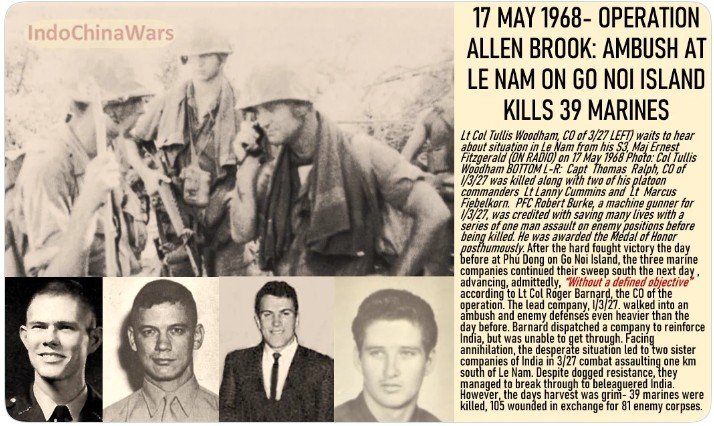
There were times when my life felt suspended, as if the world itself had pressed “Pause,” just moments before disaster loomed and I could do nothing to stop it. One such moment came on May 17, 1968, as a Navy Corpsman with the Marines in South Vietnam during Operation Allen Brook. We walked into an ambush. A Corporal was wounded in both legs, and I rushed to help. As I tightened a tourniquet, gunfire erupted above our heads. We stayed low, waiting for rescue, knowing that leaving the shallow valley meant almost certain death.
With a smoke screen behind us, we tried to reach the bunker for safety, but an enemy grenade exploded, injuring both of us. With assistance, we managed to get to the bunker alive. Our relief, however, was short-lived: enemy soldiers had surrounded it, preventing us from calling a medivac. There was a quiet pause in the gunfire as each side waited to see the other’s move. The silence was a relief, and we were thankful no one had been killed. However, we knew this peace wouldn’t last.
Ignoring orders, a renegade rescue crew quickly arrived to extract the Corporal and me from danger. As we took off, enemy fire struck several times, but soon enough, we were soaring above the war zone, beyond enemy range. I finally exhaled with relief, a faint smile appearing as I started to relax and silently thank God for His protection, not realizing that, below us, those we left behind were being overrun by the enemy, and none would survive.
The smell of smoke and the “Brace yourself, we are going down!” warning from the crew members brought me out of my meditation and back to the reality of the moment. There was what seemed like a long time, a period of complete silence, as the rotors stopped and we fell from the sky. I don’t remember the crash or the bounce that threw me out of the helicopter and onto the ground. I awoke with the helicopter on top of me. I had survived.
Looking back across 81 years, I see that my life has often been a holding pattern, waiting for something uncertain, bracing for impact. Perhaps that is the human condition: to live suspended between disaster and deliverance, between silence and fire. And always, the warning echoes, “Brace yourself, we are going down!”
The cry of the crewman has never left me. It was more than a warning in a burning helicopter; it became a refrain echoing through the years.
I have lived much of my life in holding patterns, suspended between disaster and deliverance, waiting for the next impact. Vietnam was only one valley among many. There were other valleys, illness, loss, and uncertainty, each demanding its own kind of courage.
I now see that the warning was not just for that day in 1968. It was for all of us. Life itself is a descent we cannot control, a fall we must endure. Yet survival, meaning, and even grace can be found in the bracing… in the act of steadying ourselves for what is to come.
And so, I carry these words forward, not as fear, but as truth, for in bracing, I have found not only survival, but the strength to keep telling the story.
“Brace yourselves, my friends; we are going down!”
This is a redacted version of No Heroes. The full version can be found in the book Letting Go, available on Amazon.
As writers, we breathe life into characters who begin as little more than names on a page. With each sentence, they grow, acquiring quirks, desires, and destinies until they feel as real to us as the people we meet in daily life. By the time the story ends, they are no longer inventions but companions, each having taught us something new about existence itself.
But imagine if those characters could step beyond the ink. They would awaken only at the moment of their first appearance, unaware of the role they play in the larger narrative. They would not know their fate until the final chapter… unless, of course, they stumbled ahead by accident or were granted a rare glimpse of the ending by the author.
As a child, I was taught that God knows everything, past, present, and future. At the time, this troubled me. If the story of my life was already written, what freedom did I truly have? What purpose was there in living if the ending was fixed? Yet, as the years passed, I experienced moments that challenged my skepticism: déjà vu that felt like echoes of a page already read, dreams that foretold events weeks before they unfolded. These experiences nudged me toward a startling possibility… that past, present, and future might coexist, layered like chapters in a book already complete.
Could it be that we are all characters in a grand novel called Life? That our daily choices are lines we speak on the present page, while déjà vu is nothing more than the accidental turning of two pages at once? Perhaps a misplaced bookmark returns us to a scene we thought we had left behind.
If so, then long before time began, the Novelist, the divine Author, crafted each of us with intention. Every soul, every character, occupies a unique place in His story. And just as no character in a novel is without meaning, so too none of us are without purpose in the Book of Life.
As we turn the pages of our own lives, may we find meaning not only in the chapters already written, but in the spaces between them, where mystery, choice, and grace dwell together.
What do you think? Are we free agents writing our own stories, or are we characters in a narrative already complete? Have you ever experienced déjà vu or a dream that felt like a glimpse of the next page? Share your thoughts on the Discussion Page. I’d love to hear how you see your role in the unfolding novel of existence.
Posted inStories|Comments Off on Living Between Chapters
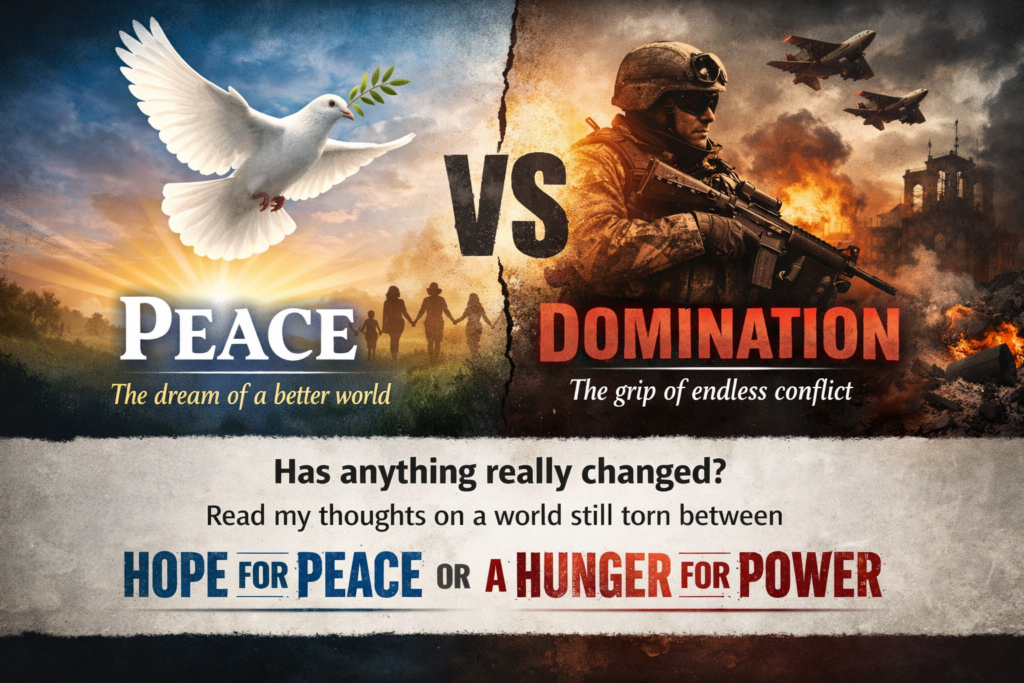
In 2009, I wrote a post about wearing black, in the hope that Goodness might prevail and the World might find Peace. Yet here we are, and nothing has truly changed. If anything, the forces of opposition have grown stronger, louder, and more entrenched. The dream of a more Peaceful World feels even further away.
I wrote that, to become a good leader, the USA would need to admit to its illegal wars, covert operations, and crimes against humanity. Instead of accountability, we see denial, revisionism, and the rewriting of history. How can we expect others to face justice when we refuse to face our own?
I wrote that, to become a good leader, the USA would need to step away from its role as protector of Israel and act as a true mediator in the Middle East. Yet decades later, the imbalance has only widened, and peace remains elusive.
I wrote that, to become a good leader, the USA would need to silence the voices of those who spread lies and hatred. But instead of accountability, disinformation has become a weapon of mass influence, amplified by social media and unchecked by truth. Freedom of speech has been twisted into freedom to deceive.
I wrote that, to become a good leader, the USA would need to rid itself of extremist groups. The religious, political, and ideological factions that claim exclusive rights to freedom while denying it to others. Yet these groups have only grown in power, shaping laws, elections, and public discourse, fueling division rather than unity.
I wrote that, to become a good leader, the USA would need to end its endless wars. But instead of pulling back, new conflicts emerge, new deployments are made, and the cycle of resistance and retaliation continues without end.
I believed once that change was possible. Today, I see a nation still convinced it is above reproach, still clinging to the illusion of dominance rather than embracing the path of peace. And so, I continue to wear Black, not in protest of one leader, but in protest of a system that values World Domination over World Peace.
Perhaps Peace will not come in my lifetime. At eighty-one years of age, the prospects look dim; however, I will not surrender the hope that one day it will. Peace will come because some of us refused to let the Dream die. We held ourselves and each other accountable and dared to believe that Truth and Goodness could still prevail.
Wayne Dale Matthysse
Posted inStories|TaggedPeace, War|Comments Off on Still In Black
In the Northern parts of the United States, the roads are quiet. No cities to slow you down, no travelers to share the miles. Cruising at a hundred in a Thunderbird feels effortless when you’re the only one on the highway. Everything was smooth until I reached the Upper Peninsula of Michigan, where the sky broke open, and rain came down in sheets. Even with the wipers thrashing, the road blurred into gray. Then, without warning, the highway ended. A detour sign with blinking lights glowed through the storm.
I followed the narrow road for miles until the rain stopped just as I crossed a small bridge. Pulling over, I unfolded the map and realized the road I was on led deeper into the wilderness, not back to the highway. Doubling back would mean missing the ferry to Drummond Island and another night sleeping in the car.
“Okay, Lord,” I shouted into the silence, “what possible good could come out of this?”
The answer came instantly with a loud knocking on the roof and a voice calling, “You love Jesus? I Jesus!”
I turned to see a blond-haired, blue‑eyed boy peering through the back window, another pulling a backpack from beneath the bridge. “What?” I stammered, still in shock.
“I Jesus,” he repeated, pointing to the sticker on my window: HONK IF YOU LOVE JESUS.
His name was Jesus, and he and his friend were from France. They’d started in New York, bound for California, but ran out of money and decided to head for Quebec to visit an aunt. They had seen the same Detour sign, and the storm had driven them under the bridge. They were wet and hungry, and feared they would spend the night under the bridge in the wilderness. I told them of my plans to visit family, and they asked to come along. We wouldn’t make the ferry that night, but the first one in the morning would do. They were glad to be with someone who knew where he was going.
As we drove back to the highway, we looked for the Detour sign that had brought us together, but there was none.
We reached the docks nearly an hour late for the last ferry, expecting darkness and sleep. Yet the ferry was still there, delayed by mechanical trouble. My family, who had crossed earlier to shop, were parked just two cars ahead. The French boys fit right in — laughing with my sisters, sharing stories until the next afternoon. When I took them across the bridge to Canada, they thanked me for sharing my family. Then Jesus asked, “Are you an angel?”
“No,” I said, smiling. “I’m not an angel.”
He shook his head gently. “Yes, you are an angel for me.”
Those words stayed with me during the long drive south to Hudsonville; I knew what they had seen was not me or any angel, but God’s love — shining through the detour, the storm, and the narrow road that had led us all to Light.
The past few weeks have been a whirlwind with Melinda and Kate visiting. Their presence brought us closer to many Wat Opot children and families, reminding me how much I cherish stepping into a grandparent’s role, supporting without leading, watching parents guide their little ones with love.
While Dr. Kate was here, a former Watopotian welcomed her first child. At just seventeen, she faced the daunting challenge of delivery, and Kate witnessed firsthand the struggle and courage it demanded. Another young mother, only fifteen and in her third trimester, awaits her own child. Though married, both she and her husband are orphans, navigating life without the safety net most of us take for granted.
Dara and I feel a deep responsibility toward these young people, even though they no longer live with us. They fill our thoughts and conversations, and like any parents at heart, we worry about their well-being and the paths ahead. It is heartbreaking to see them in such circumstances at such tender ages. In moments of fear, one might wish to rewind time, to undo the pregnancy, to return to innocence. But reality calls us to shift our focus, to nurture hope, to prepare for futures that can still hold promise.
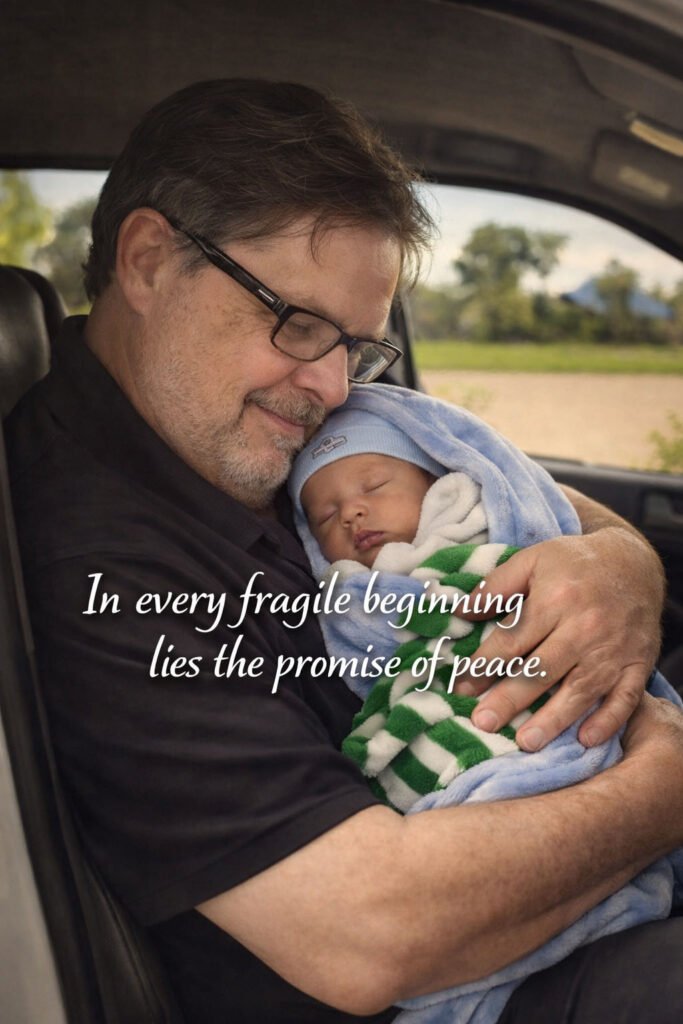
Pregnancy often stirs doubts and anxieties, and modern technology, though revealing, cannot erase uncertainty. Right up to the hour of delivery, fears linger… until the moment arrives: the birth of a new life, fragile yet infinite in possibility.
This week’s birth has stirred deeper reflection in me. The youth and children I work with are my purpose, but I also carry concerns for humanity itself. It seems to me that mankind is in its own third trimester—struggling through labor pains, weighed down by uncertainty, yet carrying within it the possibility of something new. And just as every child’s arrival brings hope, I believe our collective labor will one day give way to the birth of PEACE for all of humanity.
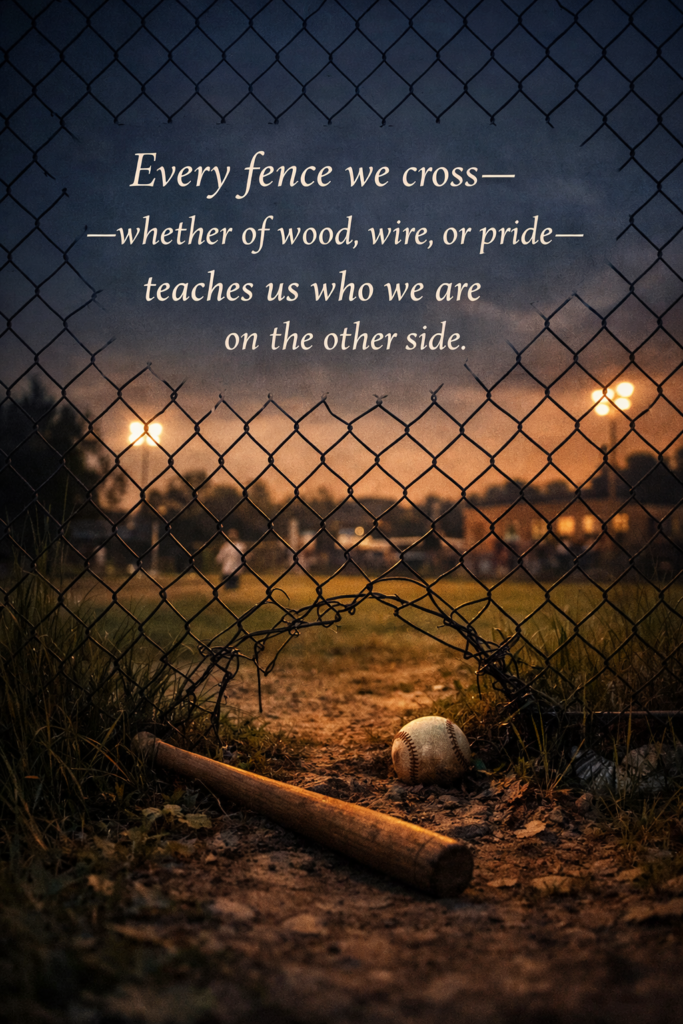
As a boy, my father played semi‑professional baseball in Grandville, Michigan. He earned a few dollars each game, but money was tight, and our family often couldn’t afford tickets. Mom, ever resourceful, usually found a way to get us in, until one night a new gatekeeper refused. Dad went inside to sign in, while Mom led us back to the car.
After a while, she returned and whispered, “Follow me.” We crept along the chain‑link fence until she pointed to a hole underneath. Karen went first, then me, then Ron. Mom squeezed through last, brushing dirt from her clothes. “Don’t tell anyone,” She warned. Moments later, she stumbled into a hole, twisting her ankle.
I ran to the dugout to fetch Dad. He left the game despite the manager’s protest and carried Mom out past the suspicious ticket taker. The next day, Dr. Brooks confirmed it was only a sprain. We never tried sneaking in again.
Dad loved baseball, dreamed of playing professionally, but family came first. He gave up the semi‑pro games, though sometimes he saved enough to take us to see the Detroit Tigers. Mom rooted for the Yankees and Yogi Berra.
Because of his love for the game, Dad wanted his sons to play too. One day he brought home a new bat and ball. As the eldest, I claimed them, setting the rules for neighborhood games. If my team lost, I’d snatch the bat and ball and end the day. Then Tom Gifford arrived with his own equipment, and suddenly my rules didn’t matter. I had to learn to play by someone else’s.
I’d like to say I learned my lesson then. I didn’t… not fully. Letting go of control is hard. But here’s what I know:
The fences we crawl under as children become the boundaries we must cross as adults. Baseball taught me something I’ve carried ever since. Control is fleeting. The bat passes, the rules shift, and the innings keep moving whether we like it or not. We can cling to pride and watch from the sidelines, or we can step back onto the field and play by the rules we make together… because in the end, the game isn’t about who owns the bat… It’s about whether everyone gets a chance to swing.
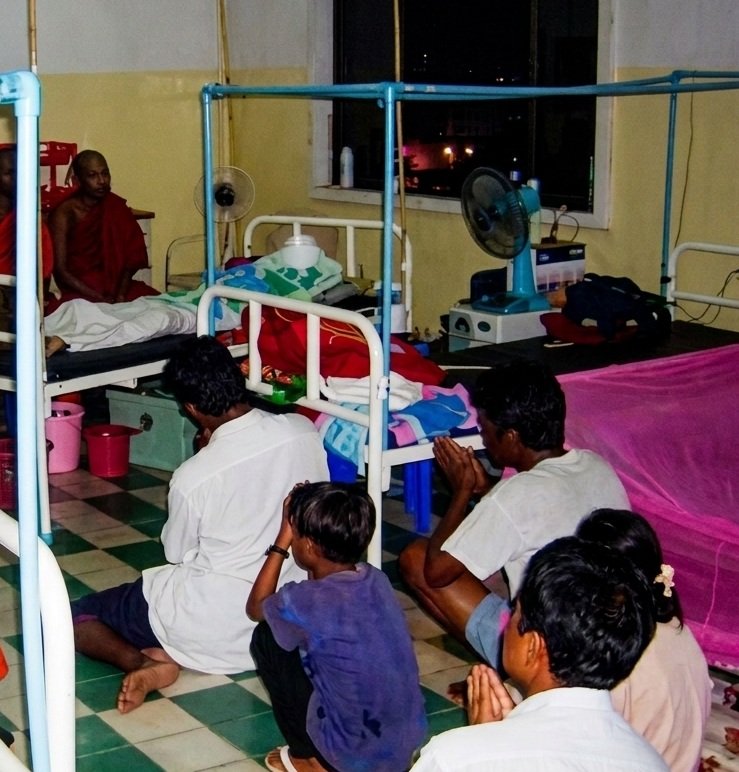
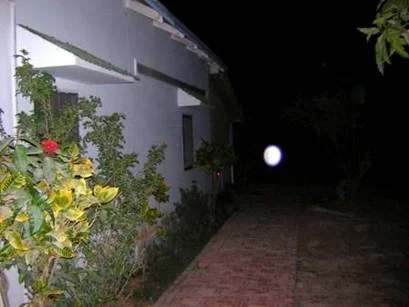
The image below was the first orb photograph I ever captured. Up to that point, I wasn’t aware of orbs, so spotting one was quite a shock. A patient had just passed away, and since the family wanted to proceed with the cremation immediately, I didn’t have time to wrap the body in a shroud. I draped a towel over his face as the monks arrived for the ceremony. During their chant, an inner voice urged me to take a photograph. Initially, I ignored it because the lighting was poor and I felt it wasn’t suitable, but the inner voice persisted. Reluctantly, I went to fetch my camera from the office. The camera flash startled the monks, and I felt embarrassed for having taken the shot. I lowered the camera and didn’t look back at the photograph again until the following day.
A year earlier, I had witnessed a light emanating from the eyes of Chhang, a young boy who died from AIDS-related complications. For that reason, I was shocked to see this orb above the eyes of this man who had just passed away—especially because I was subconsciously compelled to take the photograph.
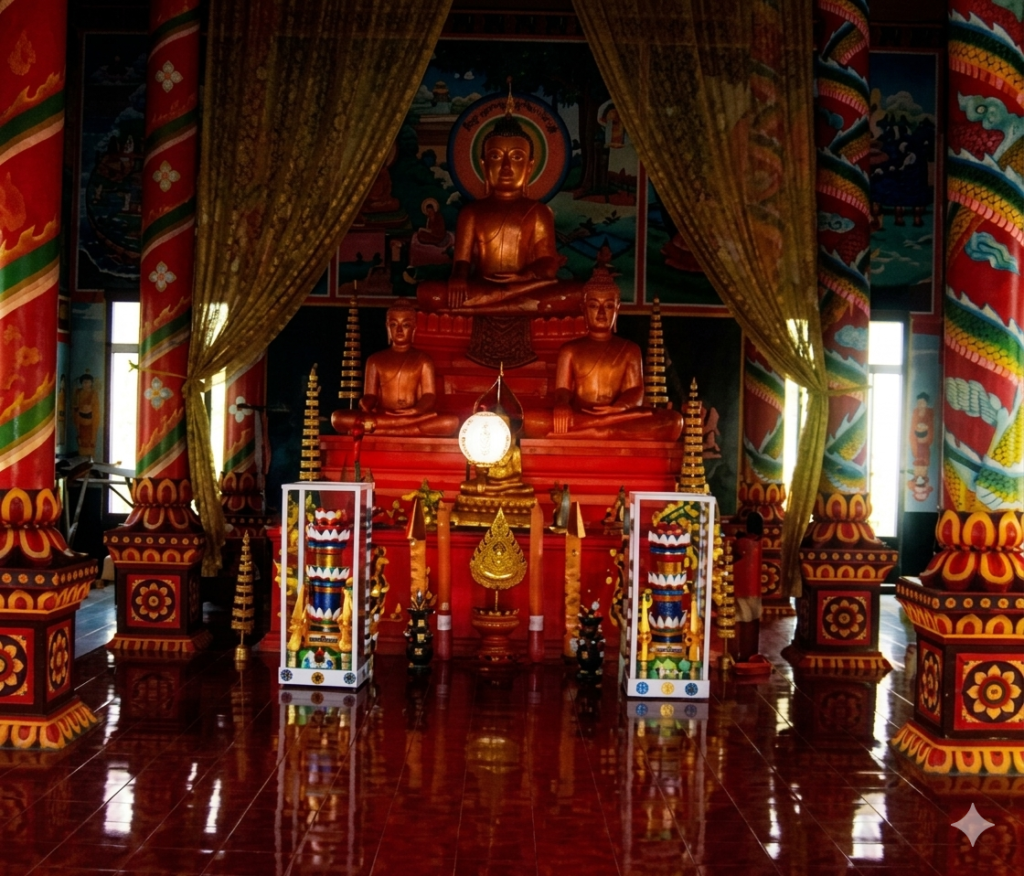
It would not be the last time we witnessed these orbs. They would appear many more times in my digital pictures and in photographs taken by other cameras. The picture below was taken after cleaning the temple—easily explained by some as dust on the camera lens.
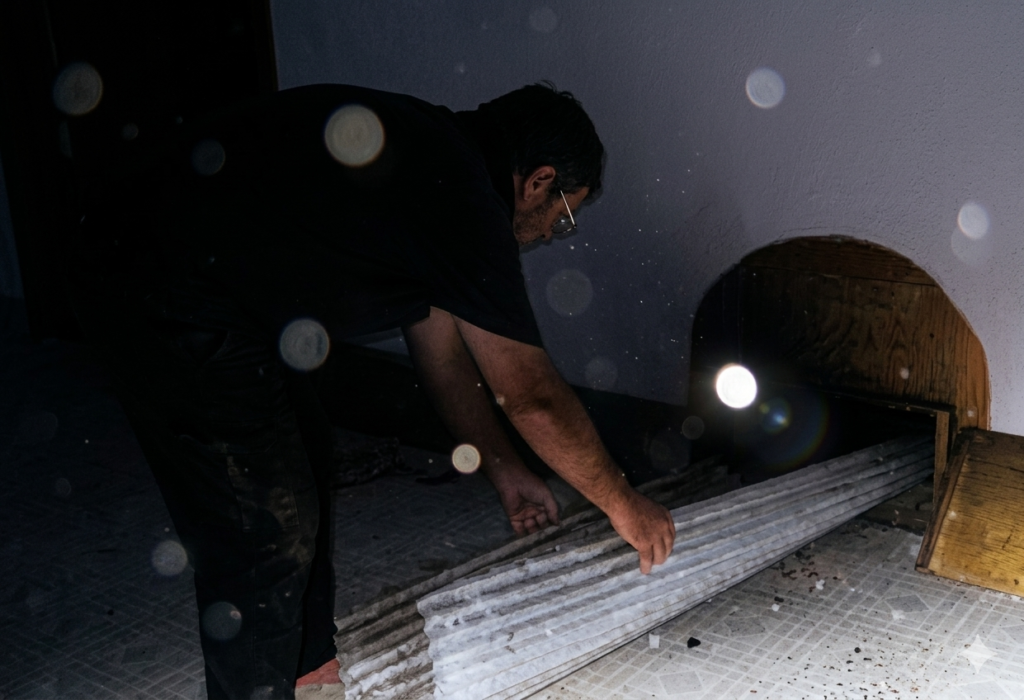
The image below was captured at night while I was cleaning the crematorium tray after a young girl’s death—some might easily mistake it for ashes on my camera lens.
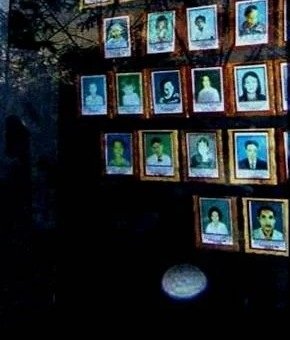
The orb at the bottom of this picture seems to be gazing at me as I stand in front of the Memorial Room window, which displays portraits of those who have passed away. I was told, “Most likely a dirty spot on the window.”
Unable to sleep one night, I stepped outside my bedroom and took this picture. I should have cleaned my camera beforehand because that speck of dust was, supposedly, still on my camera lens.
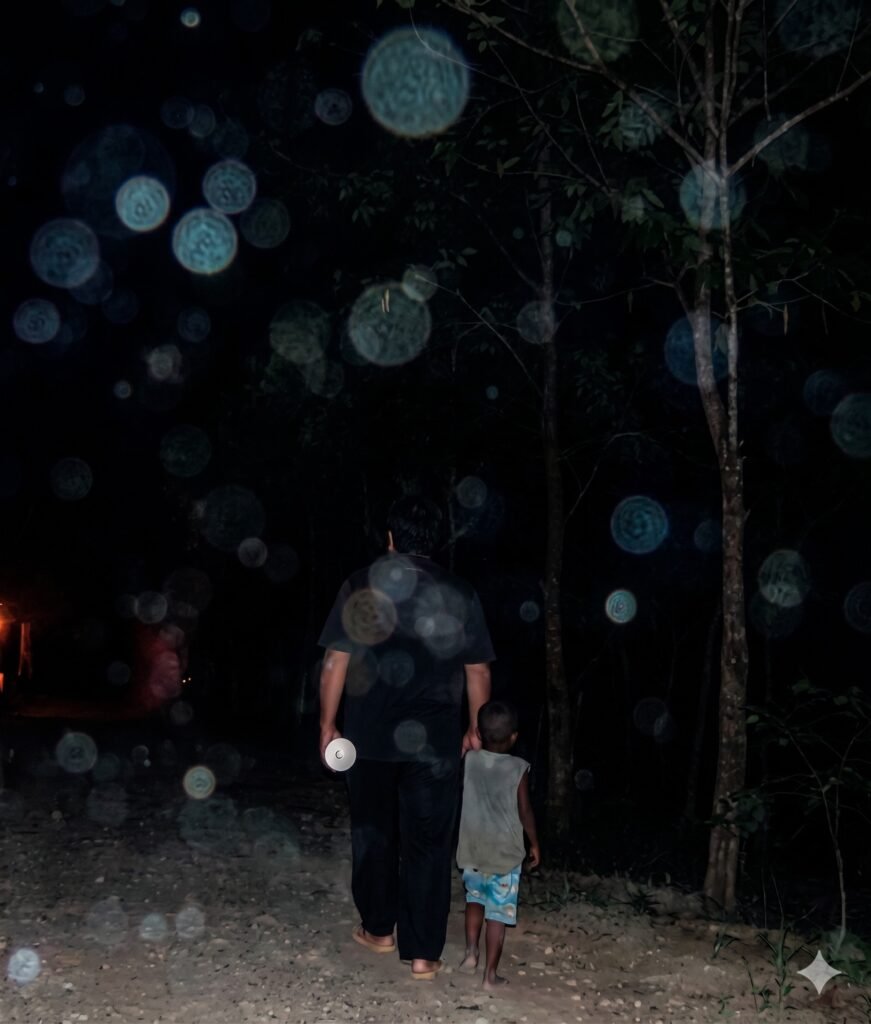
Some say you never walk alone, and the picture below suggests as much. Someone took this picture while I was walking with one of the children to the crematorium for our nightly meditation. I was not holding anything in my left hand.
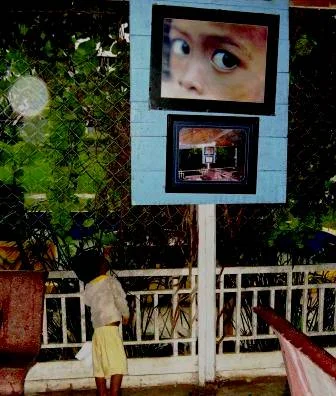
The portrait of Chhang used to hang in our outdoor dining area. It was from his eyes that I watched the light shine on the day he passed away. Just before the photo was taken, one of the children called out his name. The rain had ceased moments earlier, and apparently, a raindrop landed on my camera lens.
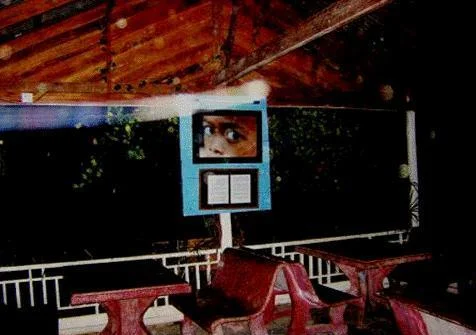
Although the images above might have logical explanations, the one below confuses even professional photographers. A moving orb seems to be traveling very quickly over the photo of Chhang on a night when children are out searching for him with my camera.
Think what you may of the pictures above—I am not trying to prove anything with them. Although they do offer some measure of comfort to me, I have yet to conclude that these orbs are spiritual. I do, however, believe that life is an eternal energy, and therefore it is feasible that some of these pictures are more than just dust on the lens.
Authors Note
Some of the pictures above were enhanced by AI, but the original picture was not changed. If you have an opinion on this subject, please share it on the Discussion Page.
Posted inStories|Comments Off on Those Mysterious Orbs
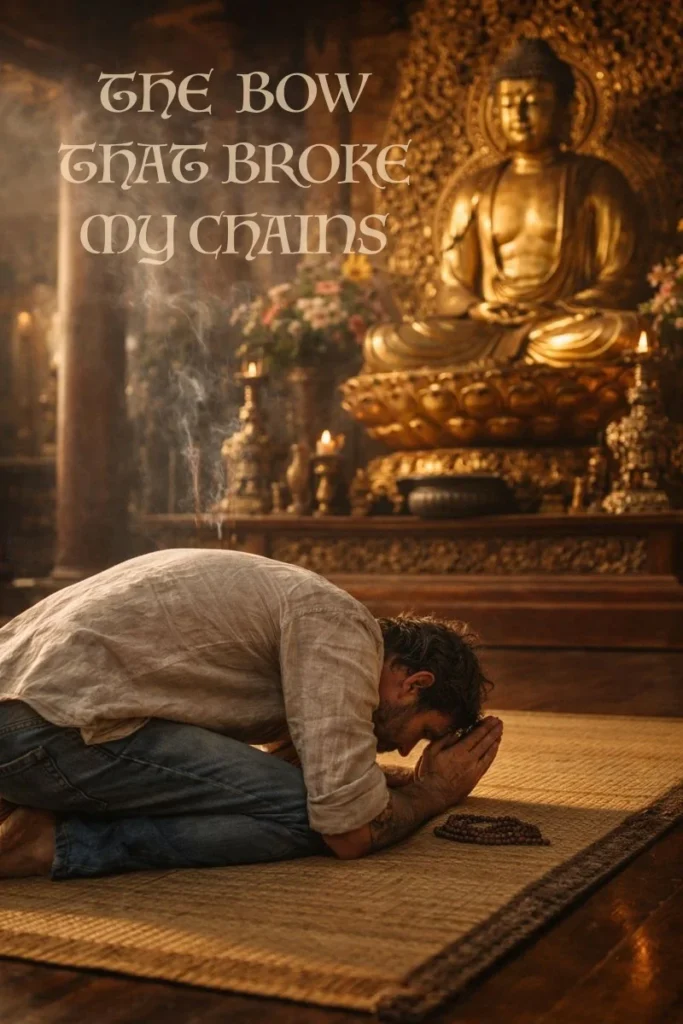
I can still remember that first time I bowed to the Buddha… such a simple act, and yet perhaps the most defiant and difficult thing I have ever done.
I have not lived the life of a saint. I’ve been a rebel from as far back as I can remember—fired from every job, court-martialed in the military, kicked off the mission field twice, branded a heretic by those who once called me brother.
Rebellion, yes. But those acts of defiance were against men, and I could justify them. To bow to the Buddha was different. For me, it was an act of defiance against the God I had known and worshiped all my life. But I was desperate—desperate to know a Truth that needed no apologies and did not require faith.
My body resisted as I began to go forward, as if bracing for a bolt of lightning through the ceiling. Nothing happened. I bowed a second time, then a third, and as I came back to sitting, a peacefulness overcame me that I had never known before. The chains of religion fell away. Its threats of hell and damnation no longer intimidated me. I was free. I felt alive—alive and one with all that surrounded me.
I no longer believe in a creator god, but that does not mean I believe in nothing. I believe the Eternal Life that unites us all, which through us creates the reality we experience, is the God I once worshiped.
The new commandment Jesus gave was not to worship a god but to love one another. In doing so, we become his disciples and can say, as he did, “If you have seen me, you have seen the Father.”
I know many will find this threatening, but I think it’s time to challenge the teachers and teachings of all religions. God is an energy to be lived, not an entity to be worshiped. From what I know of the Messengers we now pay homage to, they would most certainly agree.
I am not a Buddhist, nor do I consider myself a member of any cult. I do, however, enjoy celebrating Life with others who can accept me without conditions. For where two or three are gathered in mutual respect and agreement, there Love gathers as well in their midst.
Posted inStories|Comments Off on The Bow That Broke My Chains
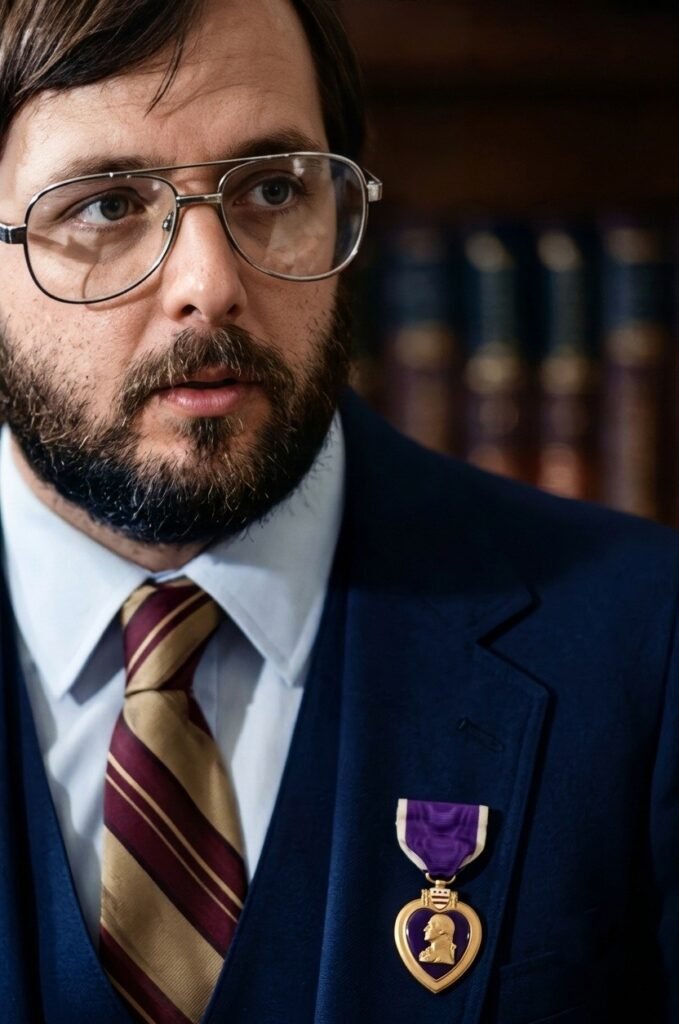
In 1984, Congressman Henry B. Gonzales awarded me the Purple Heart in San Antonio, Texas. I had not received it in 1968, when I was wounded during Operation Mallard Duck—a mission that was never meant to be survived. I was the last to leave the field alive. The medevac helicopter that carried me out was shot down, yet I somehow lived. Eleven Marines died to put me on that aircraft. I accepted the medal not for myself, but for them. I wear it proudly in their honor.
Back then, we were patriotic Christian Americans who stood for the National Anthem at nearly every public event. Many of us volunteered to fight in Vietnam against communism, and families sent their loved ones willingly. Yet beneath the surface, something was changing. The suicide mission was my first sign that all was not right. Assassinations at home, unexplained violence, and growing disillusionment revealed a deeper sickness. Veterans like me began to see it clearly.
No Heroes
“Mallard Duck? Hell—we’re sitting ducks!” our sergeant swore, slamming down the radio. His voice broke as he pleaded: “Promise me—if any of you survive, tell the story of what happened here today.”
There were no heroes in Alpha Company. No “Rambo” to lead us, no glory to chase. Most of us were replacements, new to Vietnam, still raw from the Tet Offensive. I was a Navy corpsman assigned to the 7th Marines, dropped into a company already fractured by racial tension and mistrust.
I learned quickly that survival often depended less on orders than on the men beside you. Patrols were faked, firefights staged, and resentment toward officers ran deep. Yet bonds formed across racial lines, and I began to feel accepted. Still, I had not yet faced combat. That moment would come soon enough.
Hill 55 and Operation Allen Brook
Life at Hill 55 offered brief respite—warm showers, decent food, even evening entertainment. But the war was never far. Skirmishes at the perimeter reminded us of the cost. Then came Operation Allen Brook, a march through breathtaking jungles toward the Ho Chi Minh Trail. Exhaustion set in, but our captain dismissed complaints as weakness. When the mission was abruptly canceled, we trudged back under impossible orders, driven more by fear of abandonment than by duty.
Operation Mallard Duck
The next mission was different. Mallard Duck was designed as a decoy operation: make contact, draw fire, and let bombers finish the job. But what we encountered was devastation. Villages were destroyed, wells poisoned, civilians wounded, and ignored. I watched a boy being dragged behind trees, never to return. A woman spat in my face—not out of hatred, but because to her, I was the enemy. My conscience fractured in that moment.
The ambush that followed was relentless. We were bombed by our own artillery, surrounded by hidden mortars, and cut down by machine‑gun fire. By nightfall, Alpha Company had been reduced from 160 men to barely a dozen. The staff sergeant tried to encourage us: “All we have to do is make it through the night.” But dawn brought only more orders, more impossible charges, and more death.
When I was wounded rescuing a corporal, the sergeant ordered me onto a medevac. As the helicopter lifted, enemy fire riddled its hull. Flames filled the cockpit. The last thing I heard was: “Brace yourselves—we’re going down!”
I survived the crash. The men who stayed behind did not. Eleven Marines died that day to save me.
It has taken me years to fulfill my sergeant’s last request—to tell the story. History suggests he was right: companies like ours may have been sacrificed to generate support for the war. If so, the opposite occurred. Their deaths fueled disillusionment, but they did not die in vain.
I share this now so that Alpha Company, ordinary men who gave everything, are not forgotten. With each passing day, I understand more deeply the sacrifices they made—not only their lives, but their relationships, their joy, even their sorrow.
The Enemy
The sun settled slowly
After a long and costly fight,
And I, with the rest of the men who remained,
Pulled back and dug in for the night.
In front of us in an open field,
Lay those we could not save,
Their mangled bodies stiff and cold,
Their life for freedom gave.
I sat alone on listening post,
But nothing could I see,
Yet across the field at another post,
I knew one sat like me.
I wondered if by chance he too,
Was trying not to cry,
Remembering all the friends he’d lost,
Asking why they had to die.
Then suddenly my feelings changed,
No hatred could I find,
How strange that this, my enemy,
Could have feelings just like mine.
I wanted then to meet him,
But would he understand,
If I stood in peace before him,
And offered him my hand?
Just then, I heard a shot ring out,
And I knew it could never be,
For the young man across the field,
He was my enemy.
And so I put away my thoughts,
And forgot about my friend,
For in the morning, we’d probably meet,
And for one, it would be the end.
This simple poem, written during recovery, captures the paradox of war: that even across battle lines, the enemy may share the same grief, the same humanity.
Memorial Day for me is not about medals or recognition. It is about remembering the eleven Marines who gave their lives so I could live. Their courage, their sacrifice, and their humanity remain with me always.
Authors Note
This is a redacted version of No Heroes. The full version can be found in the book Letting Go, available on Amazon.
Posted inStories|Comments Off on Remembering The Eleven