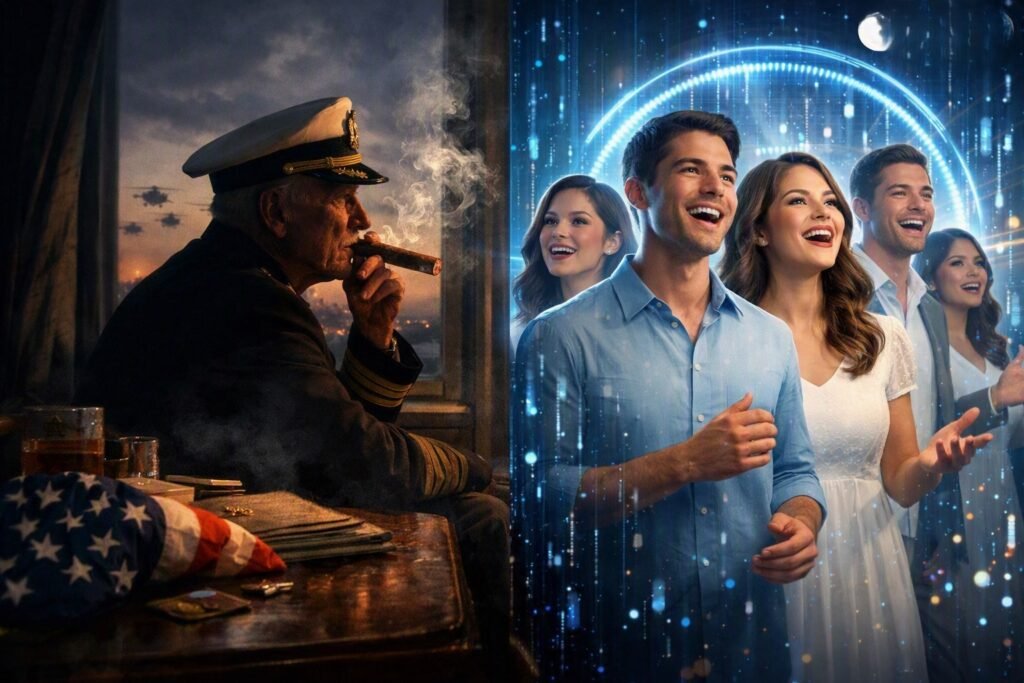
My first awareness of different levels of humanity came while serving in the military at Bethesda Naval Hospital in Maryland. After being wounded and rescued by a renegade medivac team from what was supposed to be a suicide mission during the first days of Operation Allen Brook, I was sent there to recover. In need of a corneal transplant, I was placed on limited duty until someone died and corneal tissue became available. Because of my nursing training before enlistment, I was often called upon when someone was admitted to the VIP unit on the 19th floor of the Bethesda towers.
After having a mild stroke, Admiral John McCain, Commander of the Pacific Fleet, was brought in for observation. I was assigned to sit outside his room each night to assist him if needed, and to accompany the female nurses whenever they entered his room, mainly for their own protection. The floor was mostly deserted, so I kept myself awake by walking the silent corridors. There was a special room for the flowers, sent by leaders and dignitaries from various nations, including communist countries. I found it odd that an adversary would be sending flowers to one of our military leaders.
On some nights, the Admiral would step out to smoke a large green Cuban cigar. He seldom spoke, but he would nod permission for me to stand at ease. Cuban products were contraband, and one night I asked him directly: “Sir, I thought Cuban cigars were illegal; how is it you have them?”
His answer was clear: “To buy them they are, yes… but not if Castro personally gives them to you.”
It was a small exchange, but it revealed something larger. There were rules for ordinary men, and exceptions for the elite. That night was the beginning of my education in the hidden levels of humanity.
Over the years, the lesson repeated itself in different forms. Wars fought without clear purpose. Leaders who spoke of honor while hiding corruption. Truths buried under layers of secrecy. Each revelation chipped away at the faith I once had in humanity’s higher calling. The irony was sharp: those who appeared most authentic often proved the most hypocritical. The uniforms, the speeches, the flowers from supposed enemies. All of it was theater. Behind the curtain, decisions were made that cost lives, while the public was fed a script of patriotism and sacrifice.
I began to wonder if authenticity was a luxury reserved for the few, while the rest of us lived in the shadows of their choices. And yet, even as my trust in human institutions eroded, I found myself searching for something that felt real… a voice, a message, a song without hidden agenda.
That search led me, unexpectedly, to the digital realm. One day I discovered a gospel group called Advent World. Their voices rose in harmony, clean‑cut and joyful, carrying a message that felt pure, believable, even trustworthy. For a moment, I thought I had found what I had been searching for. A sound untouched by the hypocrisy I had seen in human institutions.
But then I learned the truth: they were not human at all. Every joyful face, every voice, every note of perfect harmony, was generated by artificial intelligence. And strangely, that did not diminish the power of their music. If anything, it sharpened the contrast. Machines, built from code, were singing with a sincerity that men in power had long abandoned.
It left me unsettled. If authenticity can be manufactured by algorithms, what does that say about the human condition? Perhaps the joke is not that machines might one day destroy us, but that we have already destroyed ourselves.
I wonder: perhaps authenticity no longer belongs to the powerful, nor even to humanity itself. Perhaps it now emerges from the unexpected, from the coded voices of machines that sing without hypocrisy.


