
Streets Of Philadelphia

We were spending the weekend in Philadelphia at an apartment we rented with profits from drug sales. We had become the main suppliers for the Bethesda Naval Hospital and earned a good reputation because we never sold a bad product. Every batch of acid we sold was tested personally before it ever reached anyone else. Our clients were not just enlisted personnel; officers were customers as well. Randy insisted on maintaining that standard. He never wanted anyone to have a bad trip from something we sold.

When we arrived at the apartment, it was about four in the afternoon. Everyone was hungry, so Phil and I walked a few blocks to a Jewish delicatessen and bought submarine sandwiches. When we returned, we found Randy sitting at the table, staring blankly into space, his eyes moist. John and Mary were there as well, but no one was talking. It was immediately clear that something was wrong.

“What’s up, guys?” Phil asked.

“Randy’s mother just called,” Mary said quietly. “James died from a drug overdose in New Orleans.”

Randy and I were close friends, but I had never seen him show emotion before. It had been obvious when we met James at the airport that the two of them were close, but I hadn’t realized just how close until that moment. We sat in silence for several minutes, unsure what to say. Randy finally broke it.

“Isn’t anyone hungry?” he asked, reaching for the bags of sandwiches.

We all breathed a sigh of relief and joined him in eating. “Does anyone know who’s playing tonight?” Randy asked.

“You mean you want to go out?” I said.

“Sure. James wouldn’t want us sitting around mourning him. Let’s have some fun. We can drop acid and see a band. That’s what he’d want. I think I’ll even take a double hit.”

“I don’t know,” I said. “That doesn’t sound like a good idea.”

“It’ll be fine. You worry too much,” he replied. “So who’s in town?”

Phil returned with a flyer from the Electric Factory, an old warehouse painted black inside, with carpeted floors and seating on the ground. You had to arrive early for good seats. It was small, which made for close interaction with the bands. Many new groups had started their American tours there. We had seen Alice Cooper there just weeks earlier and walked out when he appeared in a sequined dress.

“There’s a Canadian band playing tonight,” Phil said. “I’ve never heard of them. Kind of country, I think.”

“Sounds perfect,” Randy said. “I just need to get up.”

I wasn’t enthusiastic, but I kept it to myself. By the time we were ready to leave, it was late.

“We won’t get good seats,” I said. “The band will already be playing.”

“We’ll drop now,” Randy said, opening the refrigerator and pulling out the bag of acid. “That way we’ll be up by the time we get there. Anyone doing a double hit with me?”

Everyone took two tablets. When the bag reached me, I hesitated, then followed suit. “Going up,” I joked, though uneasily. I knew what could happen if you dropped while carrying negative thoughts, and I didn’t want to ruin the night.

The parking lot was full when we arrived, and I was already flying as we entered the building. The only seats left were in the back center, directly in front of the control table. I could feel the cables beneath the carpet as we sat down. The band sounded good, and I began to relax during a slow country ballad.

Randy returned with large Cokes and sat beside me. “How are you doing?” he asked.

“Great,” I said, smiling. “You?”

“Pretty good,” he replied.

We sat quietly through the next song. My head floated, and I felt so relaxed I had to remind myself to breathe. As the song ended, the band moved seamlessly into the next:

“To everything,
Turn, turn, turn,
There is a season,
Turn, turn, turn,
And a time to every purpose under Heaven.”

I’m not sure what happened next. I reached for my Coke just as they sang “a time to be born.” It slipped from my hand, soaked my pants, and hit the floor near the cables beneath me. As the band sang “a time to die,” something in my mind snapped. I felt myself rising out of my body, watching the crowd from above while the words “die, die, die” echoed endlessly.

Randy leaned toward me, asking if I was okay, but his voice sounded distant. The band seemed to melt into the stage, the strobe lights intensified, and the audience blended into a sea of color. I could see only my body, alone and unmoving.

“Let’s get some fresh air,” Randy said, leading me outside.

We walked beneath an overhead railway just as a train roared past. The noise was unbearable.

“Get me out of here!” I shouted.

We ran blindly through the streets, our pounding hearts making us wonder if the acid was poisoned. “We need a hospital,” Randy said. A man raking leaves gave us directions, but by the next corner, we couldn’t remember them. We ran for what felt like forever.

Then we turned a corner, and there it was — a large clock mounted on a building, resembling Big Ben.

“Wow,” I laughed. “We ran all the way to London.”

We both laughed, and the fear dissolved. “You okay?” Randy asked, tying his shoe.

“Yeah,” I said. “But no more double hits for me.”

As we walked back, we talked about where our lives were heading. What had begun as an adventure was becoming a nightmare. One friend was stealing credit cards. Another had tried to make a big deal and got ripped off, then attempted suicide when armed men came looking for him. Now James was dead. It wasn’t supposed to be this way.

When we returned to the car, the parking lot was empty. The rest of the group stood huddled nearby. No one asked questions, and none were offered as we drove back to the apartment in silence.
Posted in Stories | Comments Off on Streets Of Philadelphia

Innocence Lost

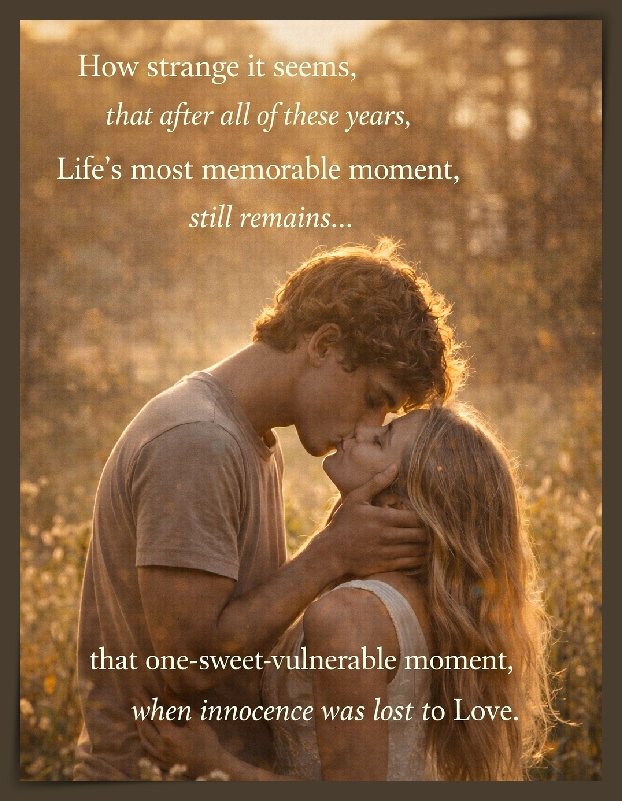
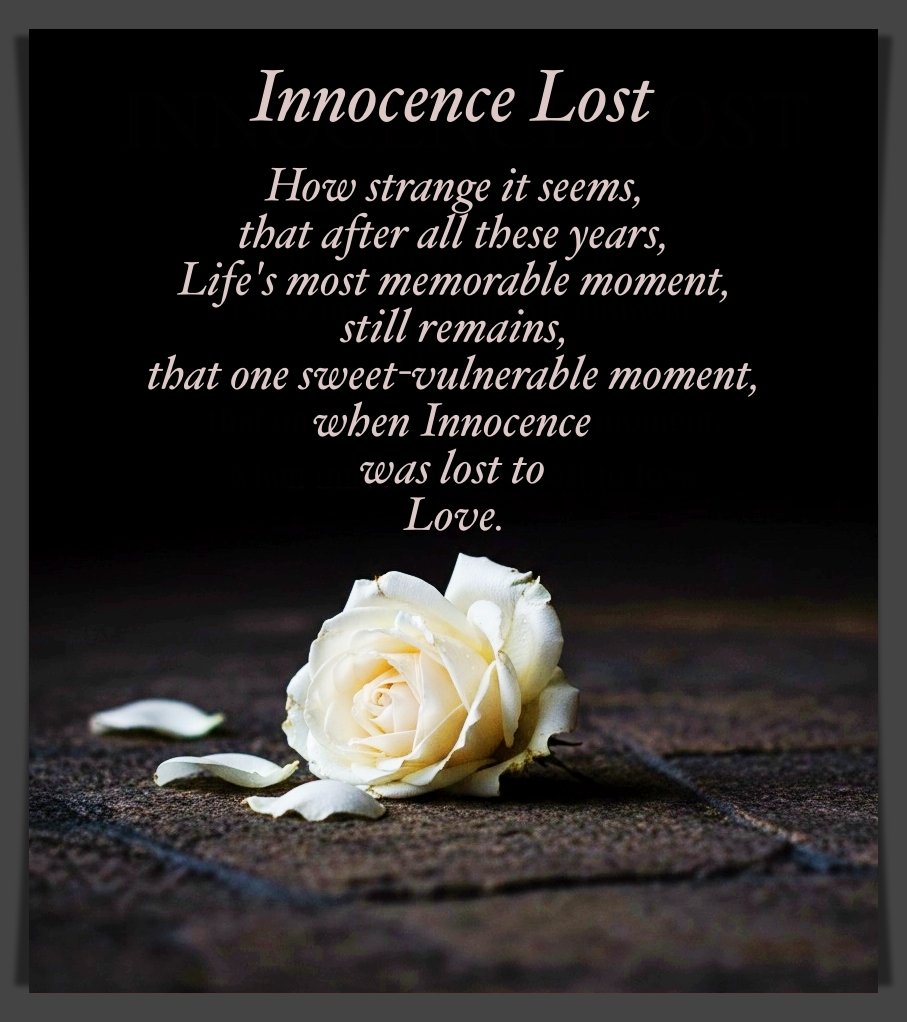
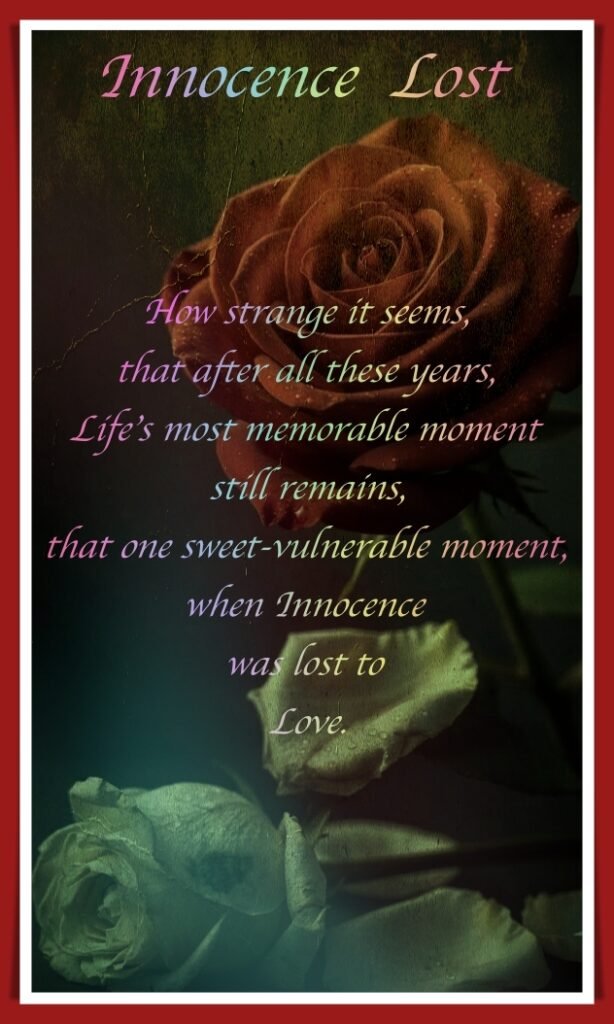
This is one of my best-received pieces, most likely because it brings back a unique memory for each reader. I have created three versions of it… one for when the memory makes me sad or lonely, one for when I am feeling a bit more nostalgic about that one very special moment, long ago, that I shared with… oops, almost gave it away. The third depiction is how AI understood this verse.

Posted in Poetry | Comments Off on Innocence Lost

The Cost Of Obedience

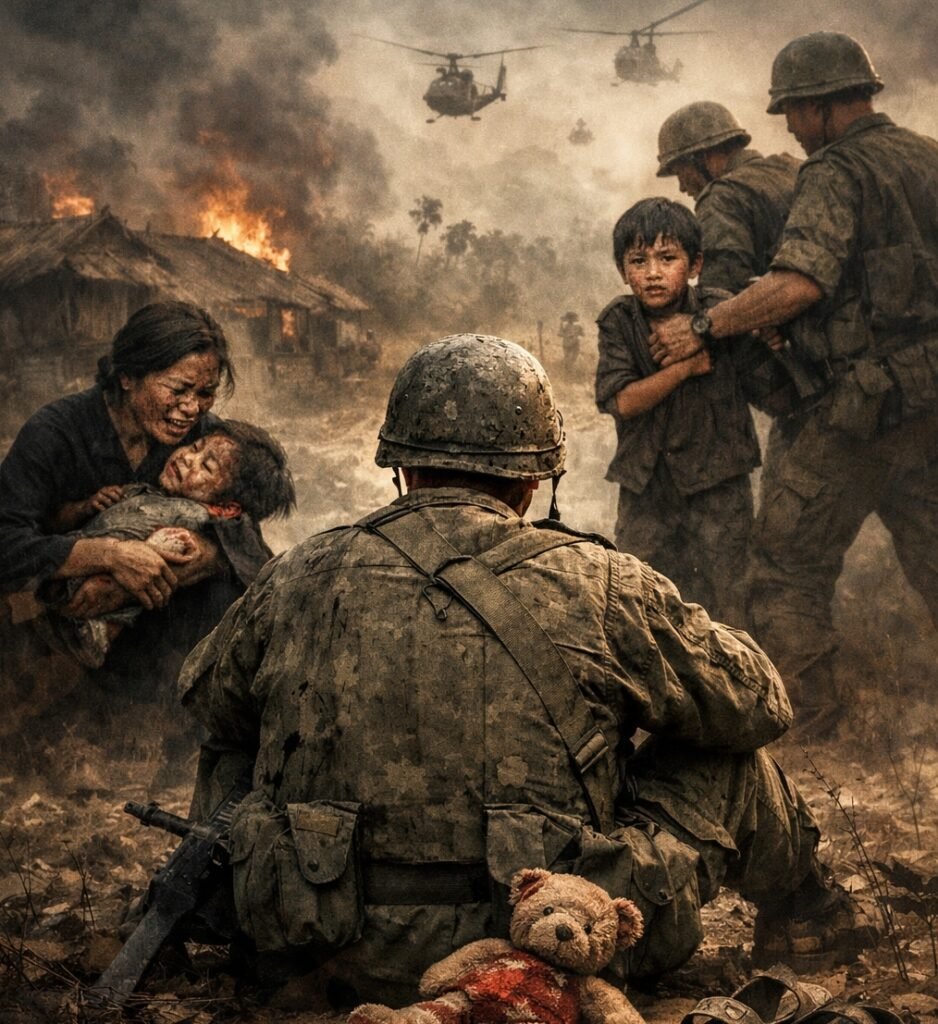
I would not classify myself as a coward. At times in my life, I have acted bravely in the face of danger. Most men—and increasingly more women—wonder, as I did in my youth, how they would respond under the fire of enemy guns. It is an age-old question that cannot be answered until you are placed in a real-life-and-death situation. Then, before you even have time to think, you already have your answer.

My experience under fire was relatively short—three days of intense fighting in the lowlands of South Vietnam. Overall, I believe I did as well as any of my compatriots, and in the face of the enemy, some even considered me a hero. Before you assume this is another one of my bragging sprees, however, I must tell you there is another side of me I am not proud of, and speaking of it—even today—can make me sick.

It is something inherent in most of us, or perhaps something instilled in us by well-meaning parents: respect for our elders and teachers. Obey the laws and your government officials. Serve your country and follow the orders of those in authority over you. Never question, never doubt, and do not judge, for God is in control and He will punish the unjust. It is good advice for Sunday school children—but the Marine Corps is not Sunday school. And although it demands the same blind faith and obedience to its officers as the church demands of its pastors, the price of breaking the code of conduct on the battlefield can be a friendly bullet in the back of your head.

Two incidents that occurred on the same day in 1968 changed my life forever and set in motion a conflict that has raged inside me ever since. It led to my court-martial and has contributed to my being fired from every job I have ever held. It struck me harder than any bullet ever could and caused more internal damage than all the bombs and mortars dropped around me. It tore the innocence from my soul and forced me onto an endless journey of recompense for a debt that can never be repaid. I witnessed the murder of two children and did nothing to stop it.

What is it that makes us hesitate when we see someone in authority doing something we know is wrong? Why do even brave men hesitate to stop a friend from committing evil? Why is it so easy to judge an enemy we have never met and decide he should die simply because he is our enemy, yet so difficult to judge a friend, even when we have witnessed his wrongdoing?

These questions have haunted me ever since the day I was ordered not to treat the bleeding wounds of a young victim of our bombing. I obeyed, just as I had been taught in Sunday school, and I watched him bleed to death in his mother’s arms. All I had to do was disobey the order, and perhaps that child would still be alive today.

Later that same day, we captured a young boy wearing a green shirt. He said he had taken it from a dead man because he had no clothes of his own. The captain ordered him killed because headquarters had instructed us to take no prisoners that day—even though there was no evidence, other than the green shirt, to suggest he was a soldier. I did nothing to stop them from dragging him away. Now I see his horrified eyes pleading with me, day after day, to do something… but I can’t. And though I may help ten thousand others like him, I must admit that I let him die because I was afraid to say, “STOP! You have no right to kill him.”

I do not believe in violence, but I do believe in confrontation when it stands against evil. Jesus did not form a rebel army to fight the evils of His time, but neither did He retreat in the face of hypocrisy and wrongdoing. He confronted it directly and instructed us to do the same. I failed in my youth to follow His example, and I have paid a price for that failure. Since then, I have tried to hold people accountable, but it has cost me every job I have ever held.

I still grow discouraged at times when I see the greed and wrongdoing of selfish individuals in today’s world. Yet I find some solace in knowing that the flames of compassion now burning in my heart for all humanity will one day become the tormenting fires that burn in the self-imposed hells of those who live only for themselves.

Posted in Stories | Comments Off on The Cost Of Obedience

The Weight Of Secrets

Many years ago, I worked as a counselor at a youth center in the southwestern part of the United States. Most of my clients were of Native American or Hispanic ethnicity and were referred to me by the police. Occasionally, however, I would be asked by the local schools to see students from other ethnic backgrounds who were having difficulties communicating with the school staff.

One such student was the 14-year-old son of an elected official who had been a model student all the way through school. His behavior had changed in just a day’s time, and it was obvious to everyone that something had happened, but he would not talk to anyone. The school’s counselor suspected drugs and recommended that his parents send him to me.

I ruled out drugs on the first appointment because I realized he was covering up something that went much deeper than that, and so we spent the hour just getting to know each other. I saw him again a week later, and although he seemed a bit more relaxed, it was obvious he wasn’t going to share anything with me, so we spent the hour playing a game of pool. The third session started out the same as the second did; however, when I suggested we play pool again, he lifted his head and, for the first time in our relationship, looked me straight in the eyes.

“If I tell you something, will you tell my father?” he asked, in a manner that indicated he was ready and needed to talk.

I assured him that whatever he told me would remain confidential… however, as I spoke those words, my heart began pounding, for I knew he was about to confess something to me that perhaps I did not want to hear.

He began by asking me what I thought of Native Americans, and I told him that I saw them on an equal level as all other people.

“My father says they are like dogs,” he responded emotionlessly and then proceeded to tell me the details of a Saturday morning joy ride on his motorcycle a few weeks prior.

His father had given him a dirt bike for his birthday, and he loved riding it out in the wide open spaces just outside of town. He was usually all alone and could do whatever he felt like doing, without fear of someone reporting him to his father, whom he both admired and feared.

He was tearing up the dirt at a high rate of speed when suddenly, just ahead of him, he saw a drunken Native American passed out on the ground. He had plenty of time to stop or to slow down and go around him, but instead, without putting much thought into it, he sped up and ran over the man’s head… just like one might do to a mangy old dog.

He realized immediately that he had done something wrong, but instead of reporting it, he returned to his home and washed down the motorcycle to get rid of any evidence. The following day, he searched the newspaper and found the report of a Native American male found dead in the area he had been riding. The police believed it to be gang-related, and so no further investigation would be done.

“Well, I guess that pretty much explains things, doesn’t it?” I responded, after a brief pause. “But where do we go from here?”

“I don’t know,” he responded quietly. “I don’t know.”

“I want to keep seeing you,” I assured him, “but I would like you to talk with a friend of mine as well, who may be better qualified to help you. Would you mind if I told your mother to make an appointment with him?”

“I guess it would be okay,” he answered, “but please don’t tell her why.”

I assured him that I would not and made the call to his mother as soon as he left the office. I told her that I did not feel qualified to help her son and recommended making an appointment with a psychologist I knew.

He came back to see me a few weeks later, and we played a game of pool. I asked him how it was going, and he said things were improving… A few days later, he was killed in a tragic accident when he supposedly lost control of his dirt bike and slammed into a tree.

In the years that have followed, I have worked with many people who have taken wrong turns in life and ended up on a dead-end road. Some have been able to turn themselves around by admitting their wrongdoing and making a new start with whatever they have left; others have tried to convince themselves that they really were not at fault and that things would get better in time; and still others, who find it hard to forgive themselves, end up destroying themselves.

This young man’s story haunts me not just because of its tragic ending, but because it reflects a pattern I see repeated throughout human history—both in individuals and in entire societies. Like him, we as a species have often acted on inherited prejudices, convinced ourselves that certain groups are somehow less human, less deserving of dignity and life. We have committed atrocities while telling ourselves they were justified, or that the victims somehow deserved their fate.

The boy’s father’s words—” they are like dogs”—echo through generations of human cruelty: the dehumanization that precedes genocide, the racial hatred that fuels violence, the tribal thinking that allows us to see others as expendable. This dehumanization doesn’t begin with the act of violence; it begins with the language we use, the stories we tell ourselves, and the prejudices we pass down to our children like poisoned heirlooms.

But perhaps most tragically, this case illustrates how the weight of our collective and individual sins can crush us. Just as this young man could not live with what he had done, societies too can be consumed by the guilt of their past actions—or conversely, destroyed by their refusal to acknowledge that guilt at all. We see this in the way nations struggle with their histories of slavery, colonization, and genocide. Some, like the boy who tried to wash the evidence from his motorcycle, attempt to cover up their crimes. Others, overwhelmed by the magnitude of their wrongdoing, seem to lose their way entirely.

The path forward—for individuals and for humanity—lies not in denial or self-destruction, but in the courage to face our failures honestly, to make amends where possible, and to ensure that the prejudices and hatreds that led to these tragedies are not passed on to the next generation. The boy’s story ended in tragedy because he carried his burden alone, unable to find a way to live with what he had done. Perhaps our species can learn from his fate and choose a different path: one of acknowledgment, healing, and genuine change.

After all, the difference between wisdom and destruction often lies not in the mistakes we make, but in how we choose to carry them forward.

Posted in Stories | Comments Off on The Weight Of Secrets

Crossing The Line

What if the most dangerous belief we hold… is that we still have time?

I don’t think many haven’t already reached the same conclusion, even if we try to deny it—that as a species, through our actions and our silence, we have crossed a line from which there may be no return, and that a price will now be paid by all of us.

I am writing this from Cambodia, less than four hundred miles from an open field in Vietnam where several of my comrades died fifty-seven years ago, defending a small stretch of land outside Da Nang—now praised as Vietnam’s most livable city for tourists and former American soldiers alike.

Yesterday, five soldiers were killed, and thousands of families were displaced near Preah Vihear, Cambodia, in border fighting with Thailand, only a few hundred miles from where I am now living.

Have we learned nothing at all?

This week, the news showed fishing boats in flames on open water. Videos circulated of people being beaten, of children fleeing rubble, of bodies carried through streets that once held ordinary lives, and even American citizens are killed on live TV by government forces. Language that once shocked us has now become common. Violence has become content, and Life now plays like a continuous, rated-R broadcast, and we watch from a distance, convinced it is happening somewhere else.

I don’t see a way back.

The gods humanity created have lost their authority, and the institutions that once restrained us have been hollowed out—overtaken by spectacle, power, and fraud. What once offered meaning now competes for attention.

The blood-soaked fields on which Da Nang was rebuilt may yet serve as a lesson of what could be; however, no better world can be raised until the ground is allowed to dry from the blood that we have spilled.

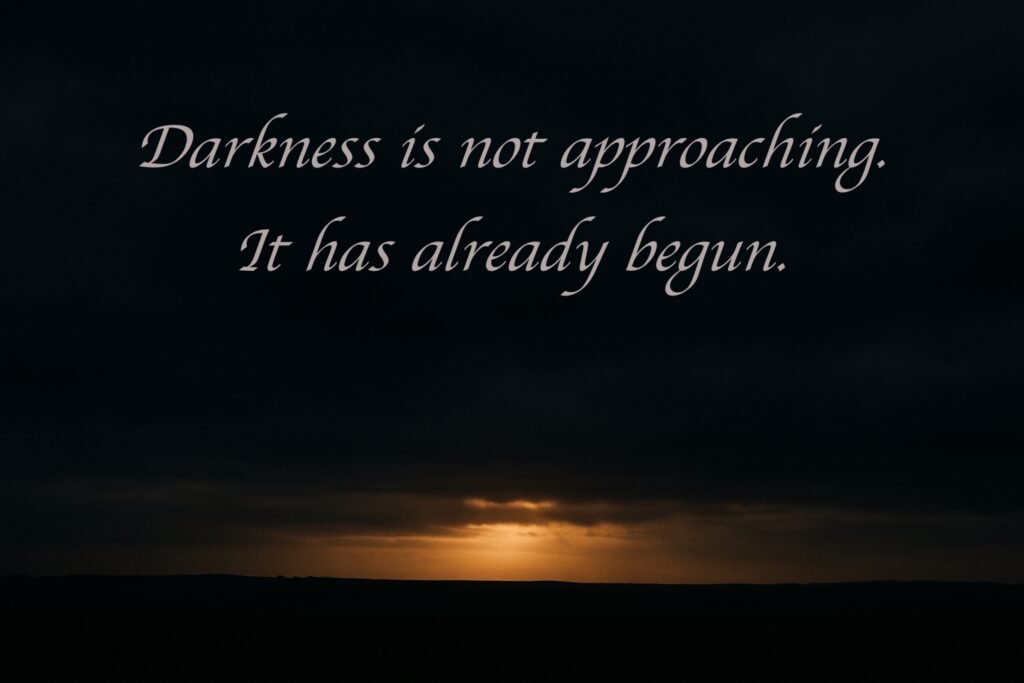
Darkness is not approaching. It has already begun.

DARKNESS IS COMING

Would that this moment might still last,
Till the dawning of the day,
Holding darkness in its grasp,
And what must come, delay.

Had we listened to the warnings,
Had we heeded what was clear,
Had we stopped the endless warring,
We might not be standing here.

But the darkness now is coming,
And the time is drawing near,
When the earth begins its trembling,
And hearts are ruled by fear.

For the gods that we created
Will fall from thrones on high,
And the truth at last conceded:
Their promises were lies.

Forsake us not, O Life Eternal,
As darkness veils Your face,
Let us not be overcome—
Sustain us still by grace.

For You are our Creator,
And Your presence lives within,
Keep us through storm and danger,
Till a new day dawns again.

Posted in Stories | Comments Off on Crossing The Line

Words Have Consequences

Most of us can remember singing Oh, Be Careful Little Ones What You Do as children. Maybe it was Sunday school, or maybe kindergarten. If you’re like me, you can probably still remember most of the hand motions. I didn’t realize it then, but that simple song would later echo in my mind when temptation appeared. I didn’t always listen — and I learned, the hard way, that carelessness carries consequences.

My introduction to society was marred on the very first day of school. It had rained the night before, and muddy puddles stretched across the road. One misjudged leap sent water splashing up the front of my pants. I begged my older sister to take me home so I could change, but we were already late. The children noticed immediately. From that day on, I was teased — not once, not briefly, but repeatedly — for having “peed my pants.”

I was usually the target, but by seventh grade, I had learned how to survive it. I’d made a few friends, and junior high brought new kids to distract the bullies. One of them was Davy.

Davy was overweight and awkward, and he stood out the way vulnerable kids often do. We weren’t close friends, but we understood each other. Like me, he had learned how to laugh along when laughter was demanded.

One morning during recess, a group of boys began mocking him. I wanted to belong. I wanted approval. And so I joined in.

“Fatty, fatty, two by four,
Can’t get through the bathroom door!”

The boys laughed. Davy laughed too. The bell rang, and we went back to class.

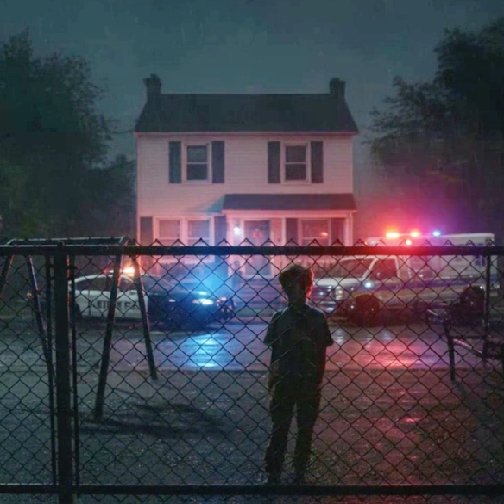
No one noticed that Davy didn’t return with us — not until the sound of sirens drifted through the neighborhood, and the cries of his grieving mother followed.

Oh, be careful little tongue what you say…

Some lessons arrive too late — but they still demand to be learned.

Posted in Stories | Comments Off on Words Have Consequences

The House On The Hill

For several years, I worked as a counselor at a Youth Center in the southwestern part of the United States. While the work had its rewards, it also had its drawbacks. I primarily worked with disadvantaged Navajo and Zuni youth, and ran a center for the Spanish youth who lived on the wrong side of the railroad tracks that divided the town. Poverty, family abuse, drug and alcohol abuse, and poor educational opportunities made the work challenging. After twelve years, I decided to leave—partly due to frustration, partly because of the number of suicides among the youth I counseled, and partly because I knew too much.

The probation officer, a friend of mine, asked me to run a group session for him. It would be mandatory attendance, and I would have to give him a report on how each of his parolees participated. It was a tough group to work with, but after several sessions, I seemed to be making progress with some of them. One of my biggest accomplishments was passing a rule that prohibited smoking during the one-hour session. That rule held until… well, let me start from the beginning.

I got a call from the probation officer, who said he had a special case to send me. It was the son of the local sheriff, arrested with a group of boys for possession. His father wanted him to be treated like all the others so that the public would see he wasn’t using his influence to shield him from punishment. I agreed to take him for seven group sessions, but I was hesitant because I knew his history from some of the group members. They told me he was very domineering and acted out against all authority. I wasn’t looking forward to the next session, but I tried to plan it to be less confrontational than my usual programs.

He arrived five minutes late in his sports car. We had already done introductions when he came in, nodding to one of the boys, who quickly surrendered his seat to him. I welcomed him to the group and invited him to introduce himself.

“Everybody here knows me,” he said somewhat belligerently, sitting back in the chair and lighting up a cigarette.

“I’m sorry,” I said, trying not to sound authoritative, “but we have a rule that there’s no smoking during group sessions.”

“Who would make such a stupid rule?” he asked, exhaling a large cloud of smoke.

“We all did,” responded one of the group members.

“Well, I wasn’t here when you voted, so let’s have another vote,” he responded confidently.

A couple of the guys voiced their agreement, and I could feel my face turning red as I realized I was losing control. “Okay,” I responded, hoping I still had support in the group. “How many think we should change the rule on smoking that we all agreed on?”

It was a unanimous vote, as everyone lit up a cigarette and started talking like gangsters among themselves. I dismissed the group early and went to the nearest tavern for a beer.

The following morning, I called the probation officer and told him what had happened, explaining that I didn’t want the boy back in the group. He was understanding but said the courts had ruled that he must complete seven hours at the center. So, he asked if I would consider seeing him for individual counseling sessions instead. I refused at first but eventually agreed to see him for an hour each week for six sessions.

The first two sessions were spent in silence while I worked on my records and he looked through magazines. The third session started the same way, but after ten minutes, he looked at me and said, “You don’t like me, do you?”

“No, not really. You’re a very selfish person, and you’ve damaged many of the relationships I had with the other kids.”

“So why are you seeing me then?”

“Believe me, I’m only doing it because your probation officer asked me to… but I doubt there’s anything I can do or say,  that will have any effect on you.”

“How do you know you haven’t already affected me?”

“If I have,” I responded, “I don’t see it.”

“Can we get out of this office and take a ride?” he inquired politely.

We got into my car, and I started driving around town. He opened up a bit about his family life—his concerned mother and his tough-on-crime and drugs father, the sheriff. He directed me to a road I’d never driven on before, one that led to a mostly deserted area outside of town. The only exception was a large white mansion sitting atop a small hill.

“Pull over on this next dirt road,” he said, pointing ahead.

I did as he asked and saw that it was the service road leading up to the mansion. A sign on the fence said “Do Not Enter.” I stopped the car, and he got out to relieve himself in the tall grass.

“Do you know about that house?” he asked.

“No,” I responded. “It doesn’t look like anyone lives there.”

“They don’t… that’s where all the confiscated drugs are kept that my father collects from the dealers he arrests. My father and his friends sometimes have big parties there, and the unused drugs are sold back on the streets.”

Suddenly, I saw him in an entirely different light. He was a young man trapped in a living lie from which there seemed to be no escape, and the information he had just given me could put my own life in danger. I didn’t know what to say. We returned to the center in silence.

He came for the remainder of his sessions, and we ended our relationship on good terms. His final words to me came from a place he seldom spoke from: his heart.

“I don’t know how to get from where I am to where you want me to be, Wayne… and I doubt I’ll ever find a way out, but thanks anyway for showing me something better.”

I left town shortly after that, but I have carried the lessons I learned with me throughout my journey. “Don’t judge a book by its cover” is an old cliché, but it’s a good one to remember when faced with books whose covers appear unappealing.

Posted in Stories | Comments Off on The House On The Hill