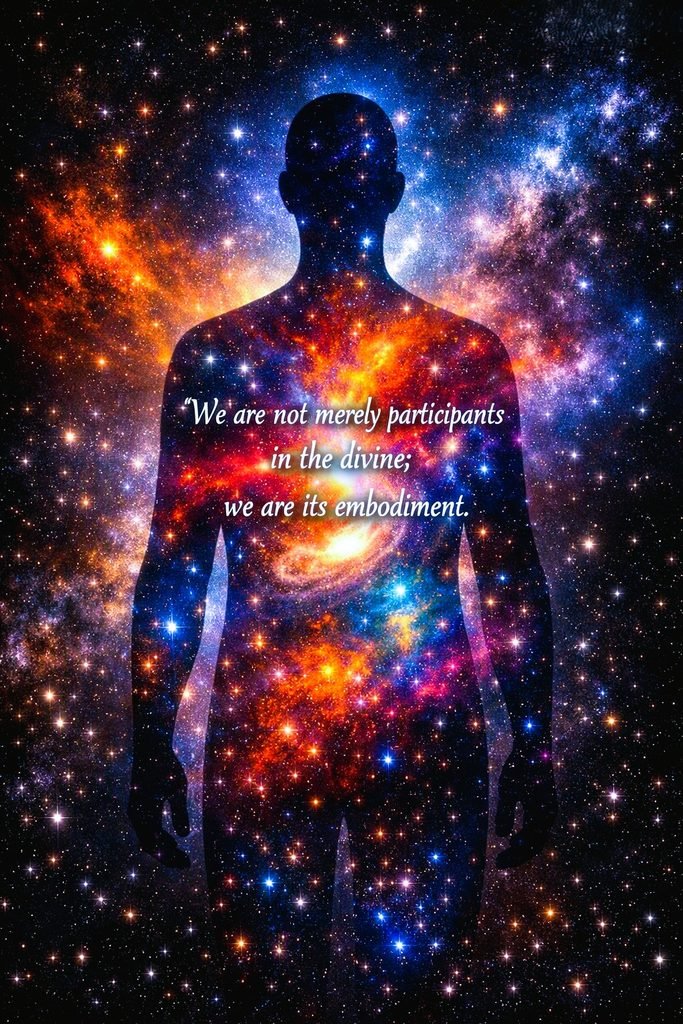
At some point, the boundary between seeker and source dissolves.
We stop reaching outward and begin to listen inward,
discovering that the light we once followed has always been our own.
To embody the divine is not to claim greatness,
but to accept the sacred responsibility of being alive.
I’ve spent much of my life watching leaders—pastors, mentors, elders—carry a quiet fear they rarely admit aloud. It’s the fear that one day a follower will wake up to their own strength and realize they no longer need a teacher. I didn’t understand that fear until I became the kind of person who depended on teachers myself.
My early years taught me how deeply people long for guidance. I was no different. As a young man, far from certainty, I chose Jesus to be my Savior. Christianity became the frame around every thought and action. I carried a Bible the way some carry a compass. Jesus was my Light when the jungle nights felt endless, my Guide when I couldn’t see the path, the bearer of my guilt, and the Crutch I leaned on when the trail felt too steep to walk alone.
For a long time, I believed I was nothing without him. I couldn’t imagine life without that external source of strength.
But life has a way of introducing us to people whose stories echo our own, even though their beliefs are entirely different. I met people who trusted ancestral spirits or the quiet wisdom of the mountains. Others placed their faith in the Buddha, the Universe, in nature, in unseen forces that guided them through hardship
And the results were strikingly similar. Their peace looked like mine. Their hope looked like mine. Their sense of being carried looked like mine.
It made me ask a question I had avoided for years: What is this human need to believe in something larger than ourselves? And why are we so willing to hand over responsibility for our choices, our deeds and misdeeds, and our salvation, to whatever name we give that “larger thing”?
Perhaps this is why religion has flourished across centuries and continents. It gives us a place to deposit our fear, our guilt, our uncertainty. But when I look honestly at the world… at the divisions, the conflicts, the competing claims of divine authority, I have to ask: Where have all these religions actually led us?
My own understanding began to shift slowly, not through rebellion but through quiet observation. Through years of watching children take responsibility for their own futures. Through nights when the stars felt close enough to touch. Through the realization that every moment of clarity I ever had came from within, not from above.
Some readers know that I now say, “I am God.” This has startled a few people, usually because they hear it as “I am a God,” which isn’t what I mean. Jesus, according to scripture, also claimed to be God, and I still deeply respect many of his teachings.
What I mean is something far simpler, and far more demanding:
If the creative force of Life lives within us, then we are participants in divinity—not spectators of it.
To say “I am God” is not an act of ego. It is an act of responsibility.
It means I can no longer blame a deity for the state of the world. I can no longer hand off my choices to a cosmic parent. I can no longer pretend that salvation lies outside myself.
My hope is not that anyone adopts my language. My hope is that each person looks honestly into their own Inner Being and discovers that the source of wisdom, compassion, and creation has been within them all along.
Once we realize that we are participants in the only “God” this Universe will ever know, we can no longer avoid the responsibility of shaping the world we inhabit. We become accountable for the creation we are part of… not as worshipers, but as co-creators.
This realization does not diminish Jesus, Buddha, or any other teacher. It fulfills what they tried to show us: the deepest truth isn’t found in following them, but in discovering who they were, within ourselves.
Your comments, questions, or reflections are welcome on the Discussion Page


