New Life

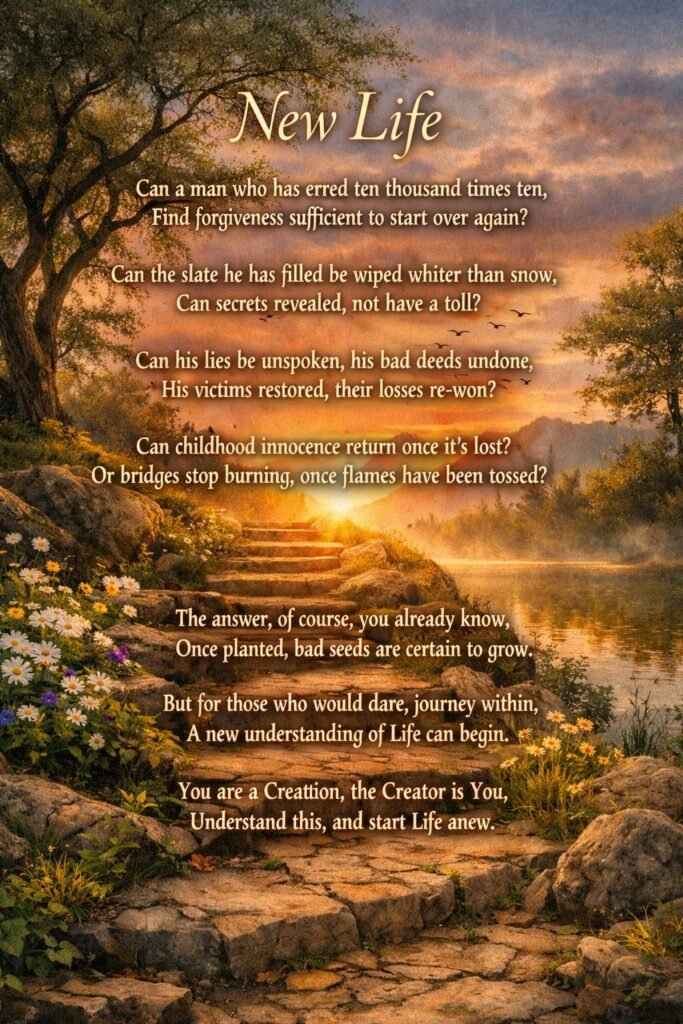
There are mornings when I wonder if forgiveness can reach me—if the slate can ever be wiped clean. I’ve carried mistakes like stones in my pockets, heavy reminders of what can’t be undone. But somewhere along the way, I realized that redemption isn’t about erasing the past; it’s about understanding it.

This poem was born from that realization. It’s my way of saying: even after ten thousand errors, there’s still a road forward. The Creator isn’t somewhere distant—it’s the quiet voice inside that says, begin again.

Posted in Poetry | Comments Off on New Life

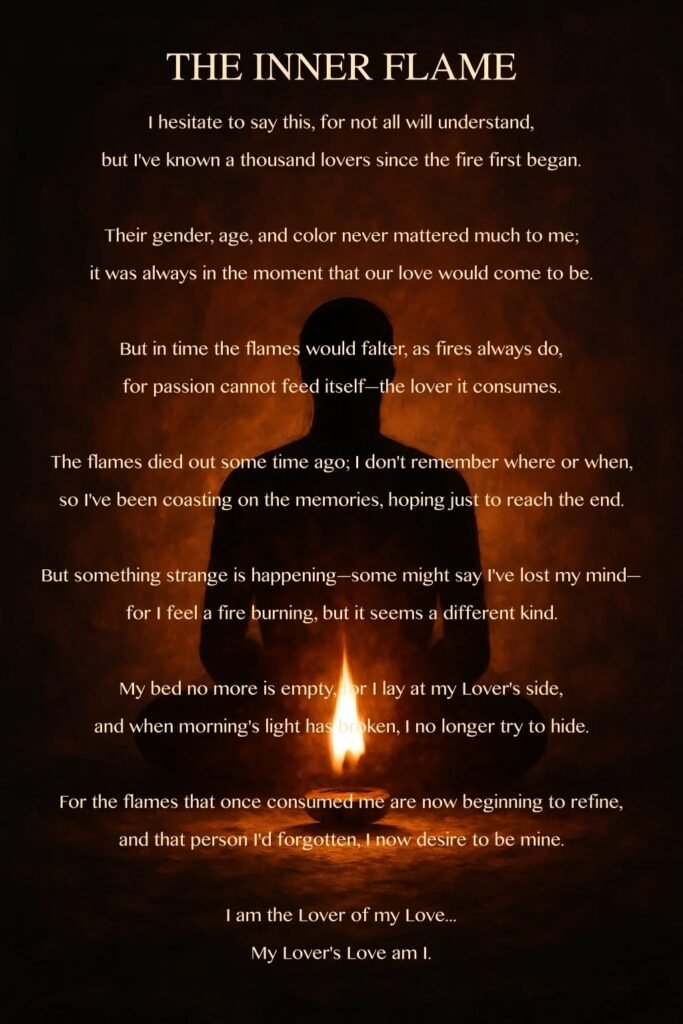
The Inner Flame

Perhaps one of the most wonderful experiences life offers us is the chance to fall in love. For some, love comes naturally; for others, the journey is difficult… and some search their whole lives without ever finding it. I have been fortunate to experience many loves during my life, and although my hair is now gray and my body finds it harder to move… I still long to love and to be loved.

I still remember my first love, a girl I knew as Sue. She had just rescued me from being bitten by her giant Saint Bernard. I had taken the shortcut through her yard many times, and each time, her dog would charge at me. Of course, he was chained and would stop just short of the path. Unaware that a longer chain had been purchased, I kept walking confidently until the dog’s jaws suddenly clamped around my leg. Panicked, I called for Sue, and she yelled his name. Immediately, he let go… but I swear I heard him chuckling as he returned to his post.

Seeing that I was a bit shaken, she began wiping his saliva from my pants with the towel she held. I could feel my knees grow wobbly from the gentleness of her touch. We were both ten years old, and had our parents allowed it, I would have married her right then and there… but time passed, and as often happens, my love began to fade… and now she’s nothing more than a memory on some earmarked page of life.

Posted in Poetry | Comments Off on The Inner Flame

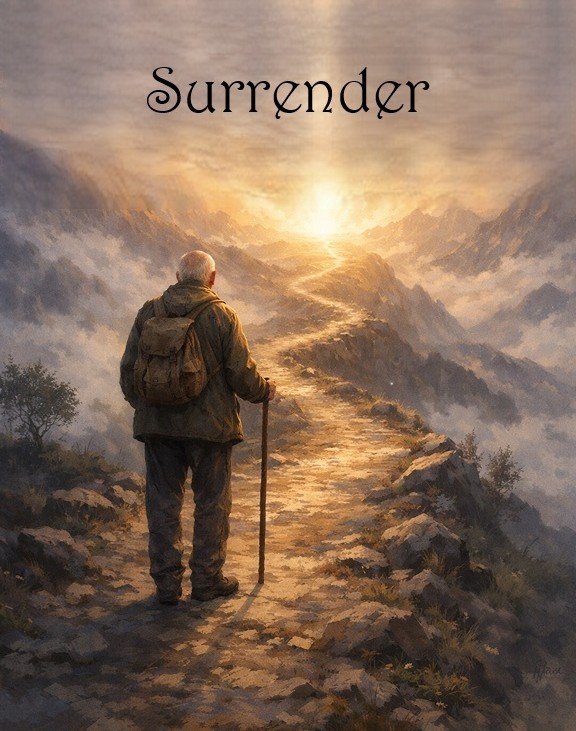
Surrender

How does one begin to write the final chapter of their Life, knowing that the last two words, THE END, will be added by someone other than themselves?

I have escaped the scythe of the Grim Reaper on so many occasions, in previous chapters of my Life, and it would be nice to think I could do it again… however, luck is limited, while death is inevitable, and eventually, everyone’s number will be called.

Don’t misunderstand me; I am not afraid of death. I have been around it most of my Life… from battlefield deaths in Vietnam, murder and suicide in Gallup, gun and machete fights in Honduras, and illnesses like HIV, AIDS, and COVID in Cambodia.  I have witnessed many Souls, young and old, leave their physical forms, often holding their hands, as they pass through the Veil. The dying process itself does not worry me, though sometimes the uncertainty of when or how it will happen can weigh on my thoughts.

About regrets, I have a few… but my biggest disappointment in Life is that I have never fully understood its essence. For example, why does good never seem to triumph over evil? I grasp the Yin-Yang idea that they balance each other, but after spending most of my Life fighting evil, I question if I was mistaken—since the more I resisted evil, the more of it I encountered. Would doing less good have created less evil?

We are living in confusing times, and much of the information we are given seems intentionally deceptive. Who deceives, and why, remains a mystery I’ll carry with me. Until then, I think it’s best to devote the remainder of the time I have left to simply earning a hug, a kiss on the cheek, or seeing a smile on someone’s face because of something I have done or said. Perhaps this surrender is, after all, the long-sought-after answer to my quest for finding purpose in my existence… and when my path dissolves into the stars, my destiny will no longer be a burden but a gift—measured not in battles fought, but in the smiles that I leave behind.

Posted in Stories | Tagged , | Comments Off on Surrender

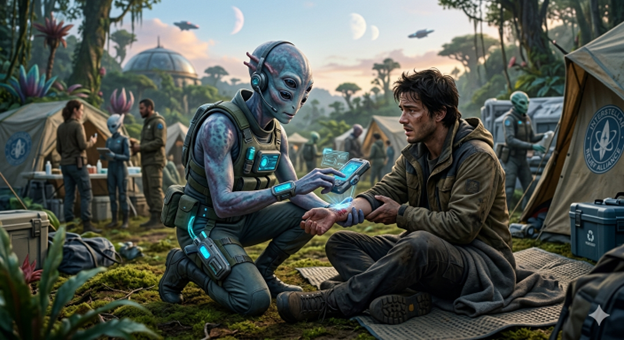
Becoming Cosmic Beings

We are born into stories—some whispered by parents, some sung in churches, some carried by nations. They shape us, but they do not define us. With time, we learn that truth is not fixed in the words of others, but discovered in the choices we make, in the compassion we extend, and in the responsibility we accept for the world we are shaping.

The universe stretches beyond our sight, vast and silent, yet alive with possibility. Whether or not other beings walk among the stars, the thought itself humbles us. We are not the center, but a part—a young species learning to stand, learning to see, learning to care. To rise, we must shed the illusions of superiority and embrace the equality of all life.

Our oceans, our rivers, our forests, our skies—they are the mirrors of our stewardship. To heal them is to heal ourselves. To lay down weapons is to lift up peace. To dissolve prejudice is to awaken freedom. These are not burdens, but invitations: steps toward becoming more than human, steps toward becoming cosmic.

The path is not easy. It winds through struggle, doubt, and sacrifice. Yet every act of kindness, every moment of humility, every choice to protect rather than destroy, brings us closer to the harmony that waits beyond. The universe is patient. It will meet us halfway, if only we are willing to walk forward.

To be a cosmic being is not to escape this earth, but to honor it. It is to recognize the divine spark in each soul, the eternal energy that binds us to the stars. It is to live as if our lives are threads in a greater tapestry, woven with care, destined for beauty.

The universe is waiting,

it’s hand outstretched,

its voice a whisper in the wind.

We need only listen,

need only awaken,

need only remember—

that the key has always been within.

Posted in Stories | Comments Off on Becoming Cosmic Beings

Liberty in Chicago

In 1966, I was training at the Great Lakes Naval Base outside Chicago. I had enlisted in the Navy with the conviction that destiny was pulling me toward Vietnam, where I imagined myself serving as a Marine Corps medic. That belief came from a recurring dream—one that felt less like fantasy and more like prophecy.

My company commander assigned me to bathroom duty. It wasn’t punishment; in fact, it was recognition. With my nursing background, I was the most qualified to keep the place spotless. Inspections were relentless, and the bathrooms were the hardest test. A streak on a mirror could cost the company its cigarette breaks or liberty passes. The upside was that I skipped morning drills and even earned a two‑day liberty pass.

Chicago was unfamiliar territory. I’d only been there once before, riding in my high school friend Jerry’s brand‑new Chevy Corvair convertible. We visited his brother at the university, but what stuck in my memory wasn’t the campus—it was the surreal sight of young women in skimpy outfits swinging in storefront windows.

This time, I wasn’t interested in revisiting that street. Instead, I headed to the USO, where I learned I could get free tickets to local events. Classical music had always been a quiet passion of mine, so when I heard the Chicago Symphony was performing that night—with Van Cliburn as guest pianist—I jumped at the chance. Mike, a fellow recruit who knew the city better than I did, joined me.

We arrived in our dress blues, only to realize the rest of the audience was in formal attire. From our balcony seats, we tried to blend in, mimicking the gestures of those around us, much like newcomers at a Pentecostal service. When the conductor introduced Van Cliburn, the hall erupted in applause. The performance was breathtaking—an evening that felt worlds away from the grit of naval training.

As Cliburn’s fingers danced across the keys, I thought about the strange path that had brought me here: a dream of war, a bathroom mop, and now a balcony seat in Chicago’s temple of music. His playing carried both triumph and vulnerability, reminding me that service—whether through art or arms—was always a negotiation between duty and destiny.

Afterward, we checked into a USO‑recommended hotel across from the Wrigley Building, lured by a military discount. Inside, however, it was clear: just boys pretending to be men. Someone had smuggled in bottles of vodka, but the hotel lacked an ice machine. Paper cups were passed around. I took a sip, gagged, and slipped into the hallway, searching for a discreet way to pour it out. On a couch nearby, one of the recruits was tangled up with a heavily made‑up woman. I wondered if she might have been one of those swinging girls from years before.

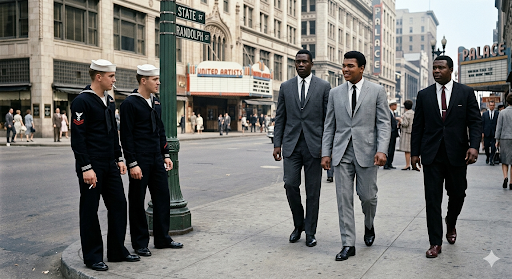
Mike and I eventually found a quiet spot to sleep. At dawn, we washed up in a bathroom and set out to find breakfast. Mike suggested a restaurant, but when the taxi dropped us off, it was nowhere to be found. Standing on the corner, uncertain, we noticed three impeccably dressed Black men approaching. Their stride was unusual—confident, almost theatrical.

“Good morning, gentlemen,” the leader said, extending his hand. “How is your day?”

“Just fine, sir,” we replied.

“I want you to know I respect you for serving our country. For religious reasons, I cannot join the military, but I appreciate those who do. Have a good day, gentlemen.”

We stood speechless as they walked away. Mike turned to me, his voice low but tinged with awe.

“Do you know who that was?”

I shook my head.

Mike smiled. “That was Cassius Clay.”

That night in Chicago, I realized life is a symphony of crossings—some marked by music, some by handshakes, all leading us down roads we never expected to walk.”

Posted in Stories | Comments Off on Liberty in Chicago

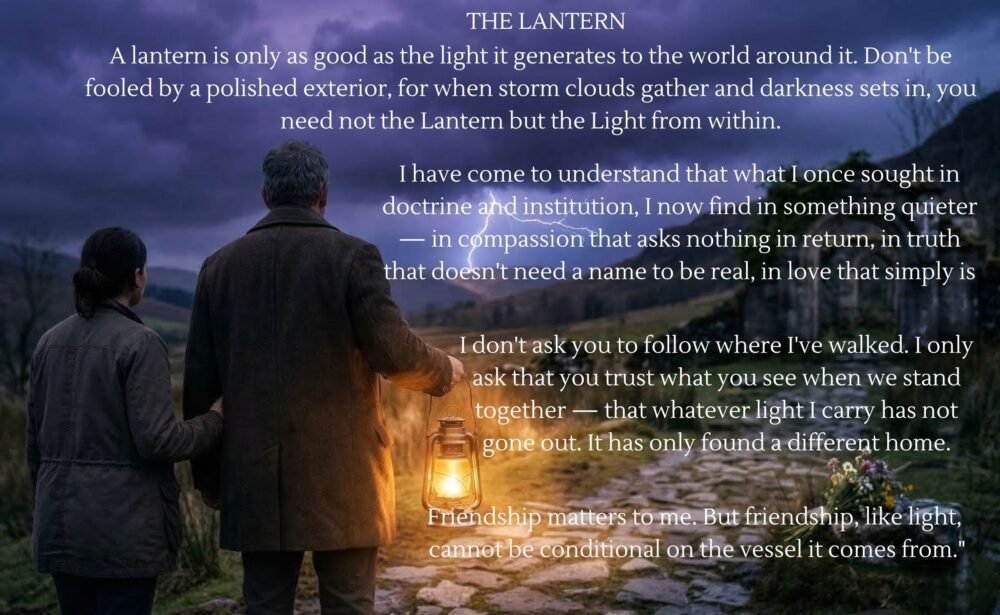
The Lantern

This verse was just recently inspired by a long-time friend who still believes I have lost my way. I do not doubt that the concern is real; however, for them, to accept anything not in the Scriptures is to go against God, for if the Scriptures are fallible, then so must be God… and that is something they are not willing to concede to.

Posted in Poetry | Comments Off on The Lantern

The Novelist And The Book Of Life

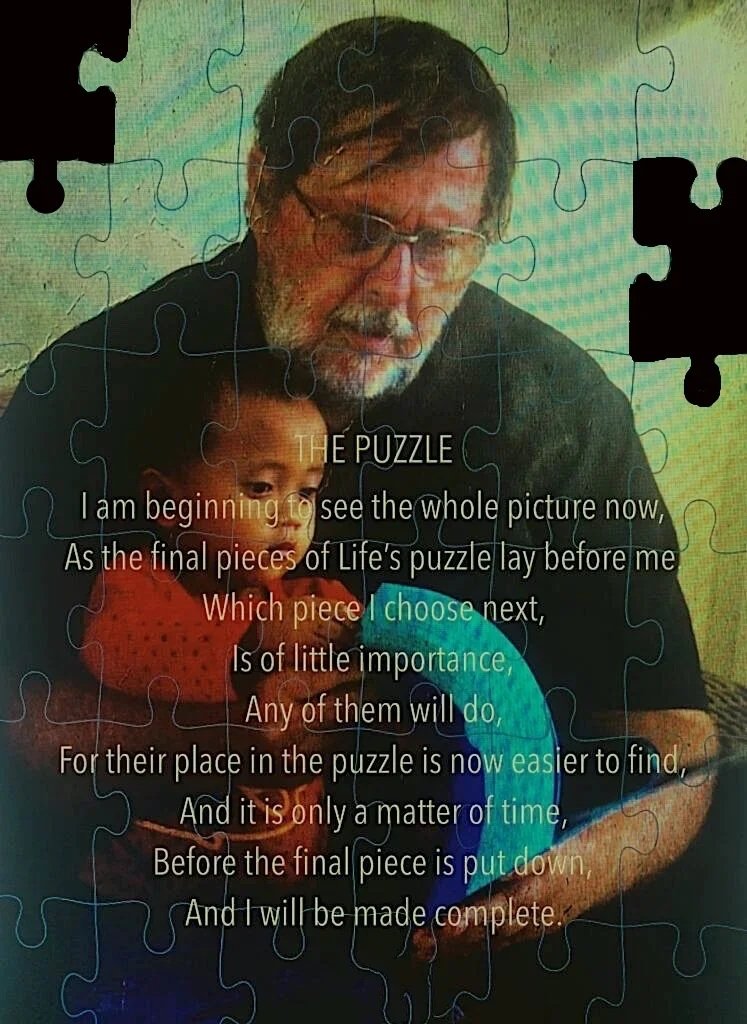
Could it be that Life’s only purpose is to put all the pieces together?

As a writer, I’ve often marveled at how characters take shape. At first, they are little more than names on a page. Yet as the story unfolds, they grow into beings with distinct personalities, quirks, and destinies. By the time the final chapter is written, they have become inseparable from the work itself. In creating them, I discover new perspectives on life, for they become—strangely enough—a part of my own existence.

If such characters could truly come into being, they would awaken only at the moment of their first appearance. They would not know their role in the story until they reached the end—unless, of course, they stumbled ahead by accident or were granted permission to glimpse the final chapter.

As a child, I was taught that God knows everything: past, present, and future. At the time, this troubled me. If the outcome of my life were already known, what freedom could I possibly have? What would be the purpose of living? Yet as I grew older, I experienced moments of déjà vu and dreams that later unfolded into reality. These experiences led me to consider that past, present, and future may coexist in ways we barely understand—that time itself may be less linear than we imagine.


Perhaps we are all characters in a novel already completed, acting out our lines on the present page. A sudden glimpse of the future might be nothing more than an accidental turning of more than one page. A sense of familiarity could be the misplaced bookmark that returns us to a passage we’ve already read.

I am open to the possibility that, long before time began, our characters were conceived by the Novelist who authored the Book of Life. And if that is true, then each of us—every soul who appears in His story—holds a place of profound significance in His existence.

Posted in Stories | Comments Off on The Novelist And The Book Of Life

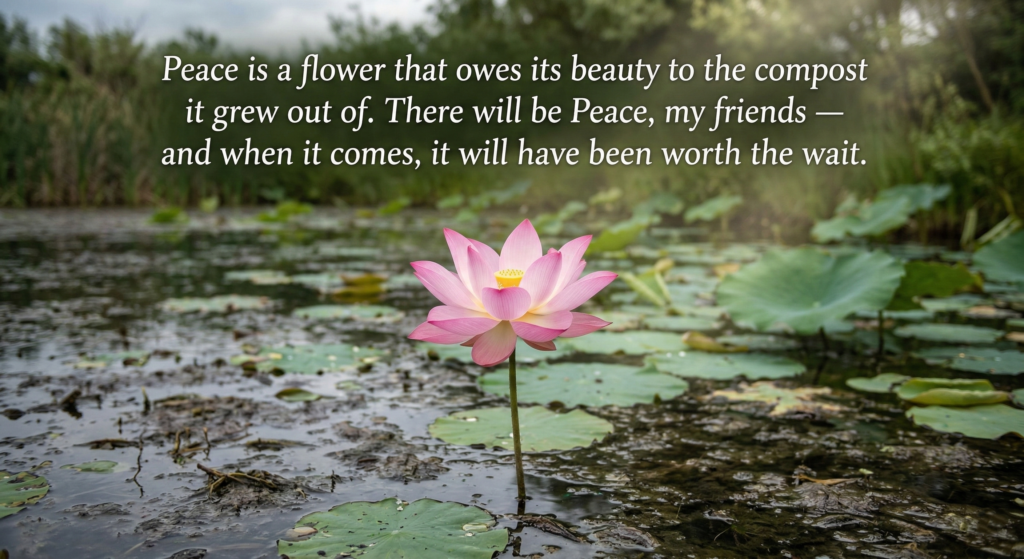
Peace Is A Flower

For many years, I have poured my heart into the work of peace — not as a distant ideal, but as a daily practice, a quiet commitment made and remade with each passing season. And yet, for much of that time, it felt like shouting into a wind that simply carried my words away. Progress, if it existed at all, was invisible to me.

These days, the world seems especially relentless in its noise. I wake each morning and, before I can even gather myself, the television delivers its familiar liturgy of conflict and crisis. I turn it off. I step outside. But the weight of it finds me anyway — drifting through conversations I never chose to have, surfacing in the worried eyes of strangers, settling into the silences between words. It is the kind of heaviness that wears you down slowly, the way water shapes stone.

But something shifted in me today.

It didn’t arrive like a revelation — no flash of light, no sudden clarity. It was quieter than that. More like a gentle surrender, a loosening of the grip I had kept on my fear. And in that softening, something unexpected slipped through: hope.

Because here is what I have begun to believe — that the very intensity of this darkness is not a sign of defeat, but of threshold. Throughout history, the moments just before transformation have often looked, from the inside, like collapse. The chaos we are living through may not be the end of something good, but the labor pains of something we have not yet had words for.

We are, I feel it now with quiet certainty, on the verge of an awakening. Not the peace we have demanded or legislated or fought over, but the Peace we have always carried within us — waiting, patient, and ready to be remembered.

Posted in Poetry | Comments Off on Peace Is A Flower

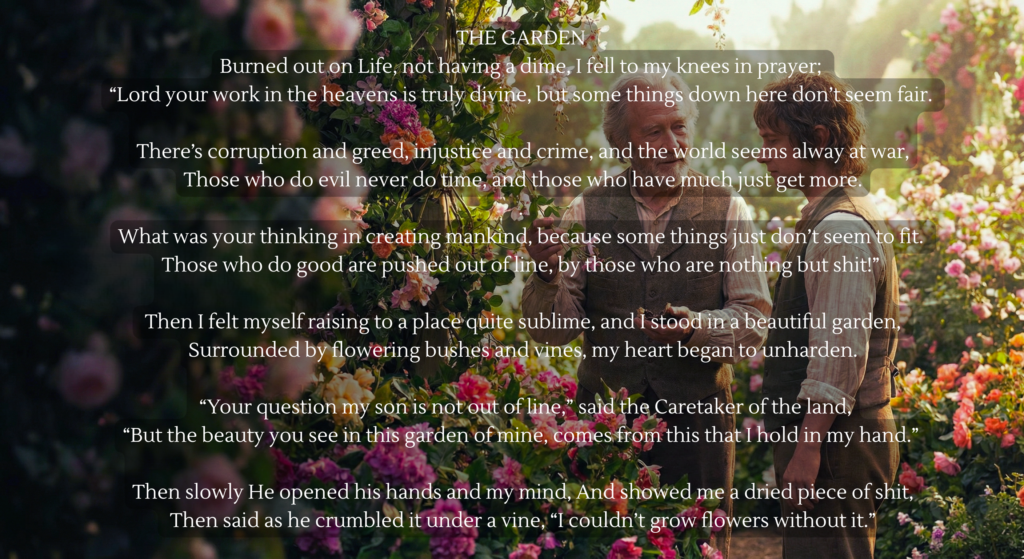
The Garden

For much of my life, I have had to deal with bullies and dishonest people who held positions over me. Most of the time, I have just walked away from the job or situation, frustrated, yes, but confident that the day would come when they would be held accountable. THE GARDEN was written after being fired by a newly hired field supervisor, who let me know, in our first meeting, that he would do everything he could to have me fired, simply because he felt I lacked the level of education and language skills necessary to be an effective missionary.

,

Posted in Poetry | Comments Off on The Garden

A Wooden Phallus

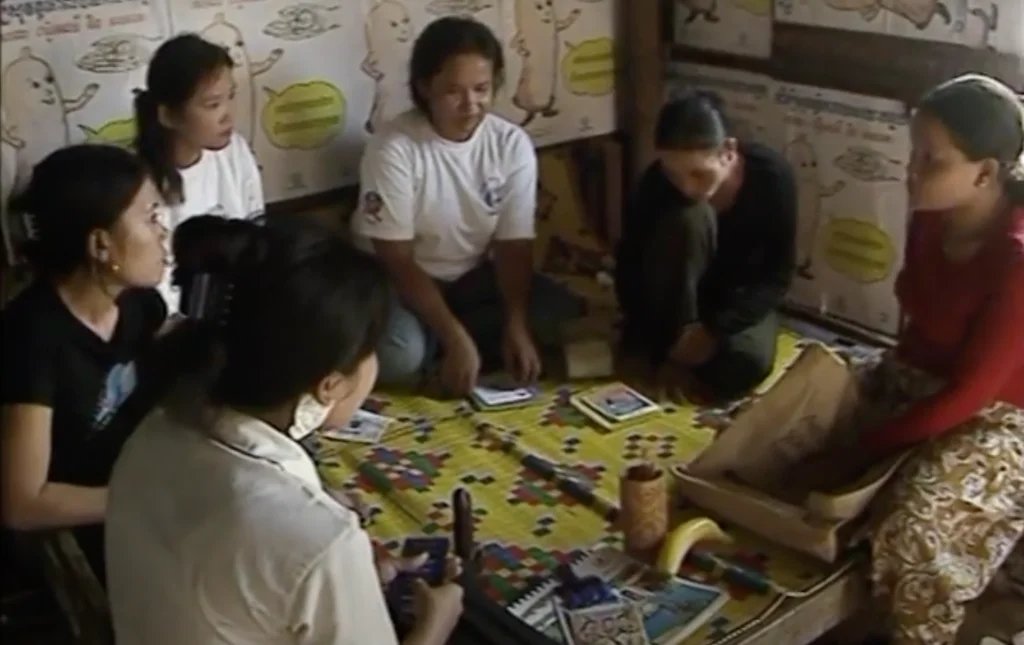
In the year 2000, I was working with an HIV and AIDS prevention organization in Cambodia. The epidemic was accelerating, and the solution seemed straightforward: distribute condoms and teach people how to use them.

Teams fanned across the countryside with boxes of condoms, demonstrating their use on bananas. We returned home satisfied with our work. But the virus kept spreading.

Follow-up visits revealed the problem: villagers were doing exactly what we’d shown them—putting condoms on bananas before sex. Our demonstration had been perfectly clear to us but completely misunderstood by them. We’d failed to account for the gap between our context and theirs.

The solution was equally simple: we used life-sized wooden phallus models instead. Infections dropped dramatically. A wooden sculpture saved thousands of lives.

But the story doesn’t end there.

Years later, a well-educated visitor from the West saw that sculpture in my desk drawer. He didn’t ask about it. Instead, he crafted his own narrative and shared it with others. His assumptions, born from a single glimpse without context, damaged my reputation. The same phenomenon. Different setting. Same root cause.

We live in an age drowning in information yet starving for understanding.

Today’s challenges—climate change, political polarization, AI safety, public health, technological disruption—aren’t primarily caused by lack of data. They’re caused by the same mechanisms that made Cambodian villagers put condoms on bananas and made my educated visitor assume the worst: We see part of the picture and believe we see it all. We receive information through our existing frameworks and never question if those frameworks fit. We mistake the delivery of information for the transfer of understanding. We assume our interpretation is obvious, universal, correct.

The Cambodian villagers weren’t stupid. My visitor wasn’t malicious. The NGO workers weren’t incompetent. Everyone acted reasonably within their own context. The problem was the invisible gap between contexts—and no one realized it was there.

This is the ignorance that threatens us now. Not the absence of facts, but the illusion of understanding. Not stupidity, but the failure to recognize that there are things we don’t know.

Consider how many of our current crises persist because we’re demonstrating with bananas when what we need are wooden models? How many solutions fail because we haven’t checked whether our message was understood the way we intended it? How many enemies have we made from people who glimpsed something in our drawer and never asked?

The antidote isn’t more information. It’s humility about what we understand and curiosity about what we might be missing. Before we dismiss someone as ignorant, we might ask: What context do they have that I lack? What am I seeing in their drawer that I’m interpreting without asking? Is the model I am using appropriate for my message to be understood?

Ignorance can be overcome—but only if we first recognize it in ourselves. The villagers learned when shown clearly. I learned when I saw our misunderstanding. Humanity too, could learn to live in Peace, if the bananas were replaced with more appropriate models.

The most dangerous ignorance is the kind that feels like knowledge.

Posted in Stories | Comments Off on A Wooden Phallus